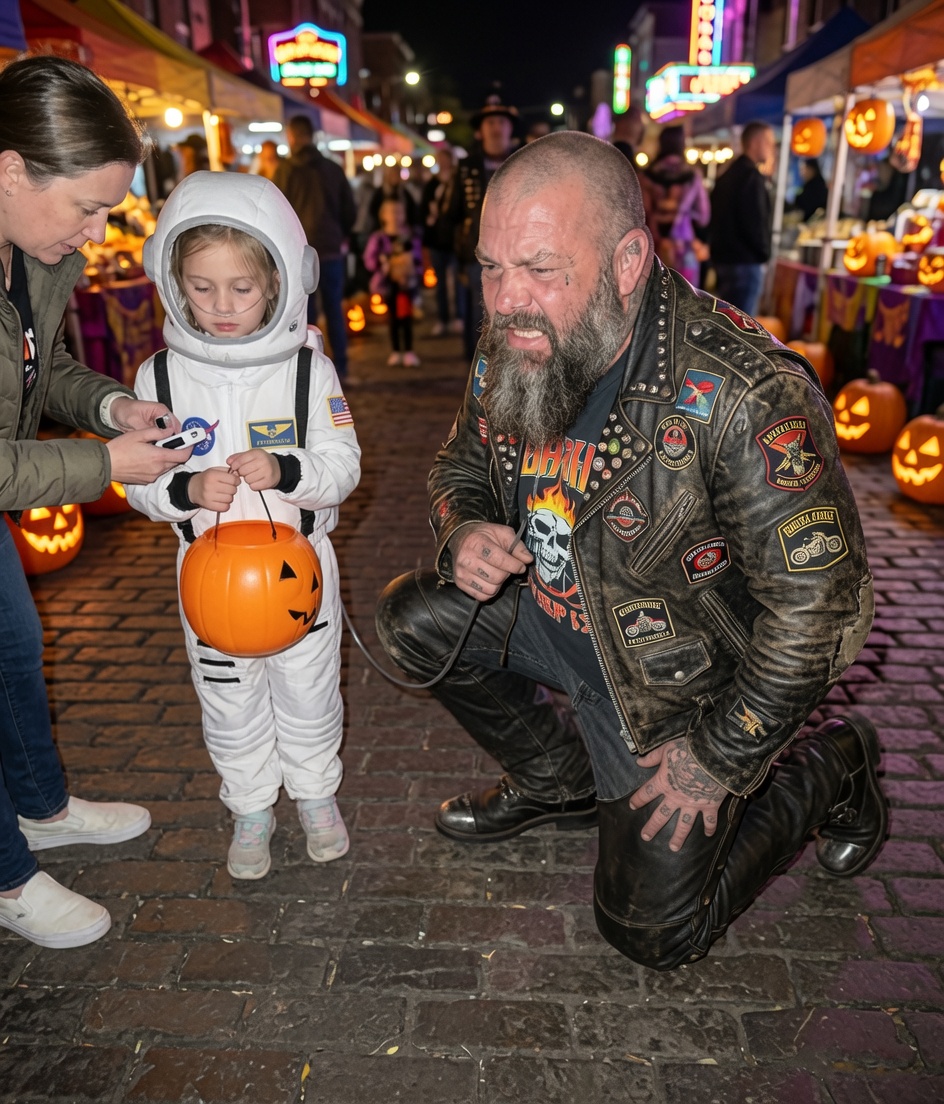
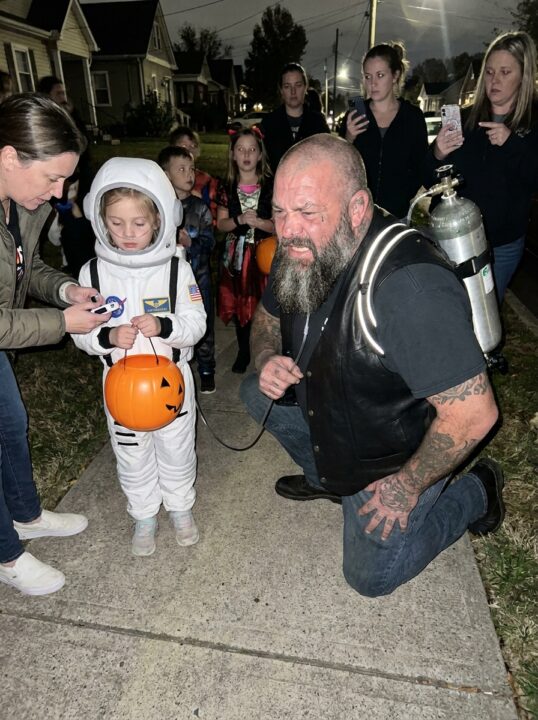
Part 2: A 290-Pound Biker Carried His Daughter’s Oxygen Tank Through Twenty Houses on Halloween—Because She Wanted One Night Like Every Other Child
PART 2 — THE HALLOWEENS INSIDE OUR HOUSE
Before the diagnosis became complicated, Ellie celebrated Halloween indoors without questioning it.
Rachel decorated the living room with paper bats and orange lights. I hid candy behind furniture. Club brothers knocked at our front door repeatedly while wearing different hats so Ellie could pretend new neighbors had arrived.
Rico used a welding helmet.
Owen placed a sheet over his leather vest and claimed to be a ghost, though his motorcycle boots remained visible.
Ellie laughed every year.
I convinced myself it was enough.
Her congenital heart condition had been discovered before birth. Surgery helped, but as Ellie grew, pulmonary hypertension placed increasing pressure on her heart and lungs. She could walk, attend school, and play, but exertion required planning.
Supplemental oxygen gave her more freedom.
People often saw only the equipment.
Ellie noticed strangers looking at the cannula before looking at her face. Children asked questions without cruelty. Adults sometimes spoke to Rachel or me instead of speaking directly to her.
Halloween magnified those problems.
Costumes tangled with tubing. Rolling cylinders caught on pavement. Crowded sidewalks increased the risk of someone stepping across the line. Porch stairs created barriers that healthy children crossed without noticing.
When Ellie was seven, she stood at our front window watching children move between houses.
“Do they know which houses have the best candy?”
“Probably.”
“How?”
“Experience.”
“I don’t have any.”
The sentence stayed with me.
The following year, Ellie chose an astronaut costume.
“Why astronaut?”
“They take air with them.”
She said it casually.
I went into the garage because I did not want her to see my face.
The costume came from a catalog, but Rachel modified it so the oxygen tubing could pass safely beneath the collar without pressure. Ellie added silver tape and insisted on a soft helmet she could remove whenever needed.
We tested the rolling cart outside.
It failed at the first sidewalk crack.
The wheels caught. Ellie turned to free it, twisting the tubing. I grabbed the handle before the cylinder tipped.
“Wagon,” I said.
“No.”
“It’s safer.”
“I want to walk.”
“You can walk from the wagon to each door.”
“That’s not trick-or-treating.”
I wanted to argue.
Then Ellie asked the question that changed the problem.
“What if somebody else carries the tank?”
Rachel looked at me.
I looked at the steel cylinder.
It weighed little compared with motorcycle engines I moved daily.
Weight was not the difficult part.
The challenge was carrying it without pulling Ellie, kinking the tubing, blocking the regulator, or creating a system that shifted when I bent or turned.
I contacted her respiratory therapist before touching any equipment.
“Bring us the design before she uses it,” the therapist warned.
I agreed.
Then I cleared my workbench.
For the next three weeks, I stopped rebuilding motorcycles after dinner.
I began building a way for Ellie to walk.