He Kicked Out His Sixteen-Year-Old Pregnant Daughter and Told the Family She Chose a Bad Life: Years Later, Colonel Patel Returned Home to Bury Her Mother and Shatter the Man Who Abandoned Her
PART 1 — THE NIGHT THE LIGHTS WENT OUT
The rain that night tasted of rust and endings.
I was sixteen, barefoot on the soaked porch, when my father’s voice cut through the storm like a rusted blade. “Get rid of it, or get out before I turn off the porch light.”
Inside, the glass he had hurled still lay in glittering shards across the carpet. Water darkened the fibers like spilled blood. My mother stood frozen at the sink, suds sliding down her thin arms, a dinner plate in pieces at her feet. The sound of it breaking had been the only thing louder than my confession.
“I’m keeping the baby,” I said. My voice shook, but the decision did not.
Richard Patel did not look at me as his daughter. He looked at me as a crack in the flawless mirror he held up to the world—the hardware-store men, the church deacons, the neighbors who still believed our family was something worth envying. His reputation was the only god he had ever served.
He crossed the room in two strides and grabbed my arm. Fingers like iron. Pain flared white-hot against bone. My mother lunged forward—“Richard, please”—and he shoved her without even glancing back. The dull thud of her body hitting the counter echoed in my chest like a door slamming shut forever.
That was the precise moment I stopped waiting for him to love me.
He dragged me to the stairs, released me so violently I stumbled, and spoke the last words I would hear from him for twenty years.
“Sixty seconds. Pack.”
I moved like someone already dead. Three pairs of jeans. Two shirts. My yearbook. I left the graduation cap hanging from the bedpost like a ghost of the girl I would never become. At the door, my mother tried to press a crumpled fifty into my palm. My father snatched it mid-air.
“She made her choice.”
The deadbolt slid home with the finality of a coffin lid. One by one, the lights died. Porch. Living room. That small, yellow glow above the kitchen sink where my mother had stood crying. I stood in the freezing rain until my sweater clung like a second, colder skin, waiting for the door to open again.
It never did.
By midnight I was calling every adult I thought might still see me as human. An aunt sighed about “no room.” A church lady offered prayers instead of shelter. My cousin Denise said helping me would “start drama.” Courage, it turned out, was a luxury none of them could afford.
A women’s shelter gave me three weeks on a narrow cot that smelled of bleach and despair. Then came the studio above the laundromat—damp walls, a radiator that only whispered heat, and night shifts at the diner where fryer grease embedded itself in my hair like shame. At three a.m., I would vomit behind the dumpster, wipe my mouth on my apron, and go back inside to scrub skillets until my hands cracked and bled.
When Ethan was born—five pounds and six ounces of fierce, fragile life—I held him on a mattress on the floor and pressed my lips to his damp forehead. His heartbeat fluttered against mine like a moth testing its wings.
“I will never make you earn my love,” I whispered into his tiny ear. “Not from me.”
That promise became scripture. The only one that mattered.
My father erased me with surgical precision. My name was banned from Thanksgiving prayers. My school photos disappeared from the hallway walls. When relatives asked, he told them I had chosen “a bad life” and refused every offer of help. The family closed ranks like a fortress.
But every two months, a plain envelope arrived at my post office box. No return address. Inside, a torn scrap of notebook paper bearing two words in my mother’s careful handwriting: Love, Mom. Wrapped around a twenty-dollar bill.
Those bills bought formula, medicine, and the first pair of shoes that didn’t pinch Ethan’s growing feet. My mother was smuggling grocery money out of the house, risking my father’s rage with every stamp she licked. She could not open the door that night, but she refused to let the darkness swallow me whole.
Years later, on a damp autumn morning when Ethan was ten months old, I walked past an Army recruiting office with him strapped to my chest. A female staff sergeant stepped out, took in my cracked hands and hollow eyes, and asked a question that changed the trajectory of my life.
“How long are you planning to survive like this?”
“Until I don’t have to,” I answered.
She smiled like someone who recognized a fellow survivor. “Then come inside.”
The Army did not care about small-town shame. It cared about whether I could march until my heels split, run until my lungs tasted of copper, and stand back up when the world tried to bury me. I could. I did.
Basic training broke me down with purpose. Officer Candidate School forged me in fire. Two deployments taught me the particular calm required when lives depend on your next order. Each promotion felt like another brick torn from that rain-lashed porch.
My mother’s notes continued. The money stopped when I no longer needed it, but the words never did.
Saw your name in the paper. Ethan looks so tall. I am proud of you.
My father never called.
Twenty years passed like chapters in a book I refused to let end in tragedy.
Ethan became a man of quiet strength who chose the Army for himself. On the morning he graduated basic training at Fort Liberty, I stood on the parade field in dress uniform, silver eagle gleaming on my shoulder. He broke protocol for one heartbeat, crossed the asphalt, and pulled me into his arms.
“You broke the chain, Mom,” he whispered against my hair.
I almost answered.
Then my phone vibrated.
An Ohio number I hadn’t seen in decades. My aunt’s voice, thin and cracked.
“Your mother died this morning.”
PART 2 — ASHES AND SALUTES
The funeral home smelled of lilies and old grudges.
I stood beside my mother’s casket in dress blues, silver oak leaves now resting on my shoulders where once there had only been rain-soaked cotton. Twenty years had carved me into someone Richard Patel would not recognize. My spine was iron. My eyes had learned the weight of command. Yet the girl who once trembled on that porch still lived somewhere behind my ribs, quiet but never gone.
Ethan stood tall beside me, his own uniform crisp, the new private’s insignia catching the low light. He had my mother’s gentle eyes and my refusal to break. We had come to bury the woman who had loved us in fragments and secret envelopes.
Richard stood on the other side of the casket like a king on conquered ground. His hair had gone steel-gray, but the same cold arrogance sharpened his features. He did not look at me. Not really. He saw only the ghost of the pregnant teenager he had thrown into the night.
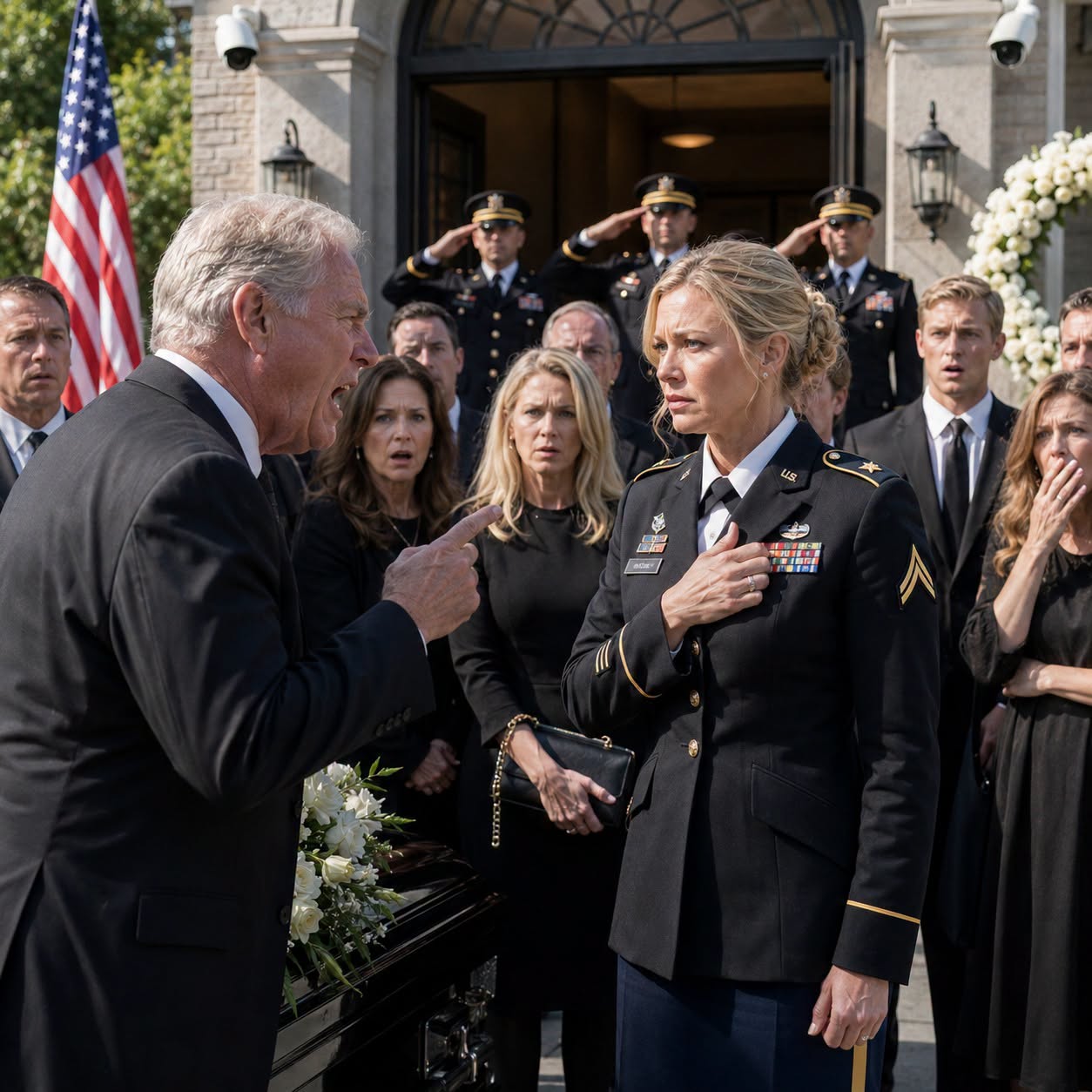
“Looks like life finally punished you,” he sneered, loud enough for every relative to hear. The words landed like spit on marble. A few aunts shifted uncomfortably. An uncle cleared his throat. The funeral-home cameras, discreet but ever-present, captured his thin, satisfied grin.
My jaw tightened. Against my heart, tucked inside my jacket, rested my mother’s final letter—the one that had arrived three days ago, postmarked before her heart gave out. I had read it so many times the paper was softening at the folds.
My brave girl,
I was never strong enough to stand between you and him. But I saw what you became. I kept every article. Every photo. Tell Ethan his grandmother loved him in silence and in stamps. I’m sorry I couldn’t say it louder.
Come home one last time. Not for him. For me.
Love, Mom.
I felt her absence like a wound that had never fully closed.
Before I could speak, the heavy doors at the back of the chapel opened.
Six Army officers entered in perfect formation—two colonels, three majors, and a brigadier general whose presence filled the room like thunder rolling in. Their dress uniforms were immaculate, rows of ribbons and medals telling stories of wars my father had only watched on television. They moved with purpose, eyes locked forward.
Richard’s smirk faltered. He glanced at me, then at the soldiers, confusion flickering across his face. This was not the script. In his version, I was still broken, still begging on porches, still the family embarrassment he could parade as a cautionary tale.
The brigadier general stopped directly in front of me. He saluted crisply.
“Colonel Patel,” he said, voice carrying through the hushed room. “The Secretary of the Army extends deepest condolences on the loss of your mother. Your service, and that of your son, honors this family more than words can express.”
The title landed like a hammer.
Colonel.
I returned the salute, my hand steady though my pulse thundered. Ethan followed, pride radiating from him like heat.
The officers turned in unison toward my mother’s casket. One by one, they rendered slow, deliberate salutes—honoring the woman who had risked everything to keep a thread of love alive in the darkness. The gesture was not just protocol. It was a public reclamation.
Murmurs rippled through the relatives. Eyes widened. Whispers spread like wind through dry grass.
Richard’s face drained of color. His mouth opened, but no sound came. The man who had once measured his worth by what the neighbors thought now stood exposed before them all. The daughter he had erased had not only survived—she had risen so far above him that the United States Army itself had come to pay respects at the funeral he believed would humiliate her.
For the first time in twenty years, his eyes truly met mine.
I saw it then—the exact moment his carefully constructed world began to crack. The realization that every lie he had told about me, every photo he had removed, every Thanksgiving he had poisoned with my absence, was collapsing under the weight of truth.
He took one involuntary step backward.
The brigadier general turned to him, expression neutral but eyes sharp. “Mr. Patel,” he said, “your daughter is one of the finest officers I have had the privilege to serve alongside. Her leadership in combat saved lives. Her son is already following that legacy.”
Another salute. Sharper this time.
Richard’s destruction did not come with shouting or violence. It came quietly, devastatingly, in the form of six salutes and the sudden, unbearable knowledge that the girl he had thrown away had become everything he had failed to be.
The room held its breath.
My mother’s casket rested between us like a bridge and a barrier all at once. I placed my hand on the polished wood, feeling the letter warm against my chest, and spoke for the first time since entering the chapel.
PART 3 — THE BRIDGE AND THE RECKONING
I placed my hand on the cool wood of my mother’s casket and felt the weight of every stolen year press against my palm.
“For twenty years,” I said, my voice low but carrying through the chapel like a command across a quiet battlefield, “I believed love had to be earned through pain. That silence was the only language a daughter could expect from her parents. He taught me that.”
I did not look at my father. Not yet.
“But she taught me something else.” I glanced down at the casket, imagining her gentle hands folding those twenty-dollar bills, writing those fragile notes in the dead of night. “She taught me that love can survive even when it must hide. That strength is not always loud. Sometimes it is an envelope with no return address. Sometimes it is the refusal to let your child disappear completely.”
A soft sob broke from one of my aunts. Several relatives lowered their heads, shame coloring their faces. They had chosen comfort over courage. They had let a frightened girl walk into the storm.
Only then did I lift my gaze to Richard Patel.
He stood smaller than I remembered. The sneer had vanished. In its place was a hollow mask of disbelief and something deeper—fear. Not of me, perhaps, but of the mirror I had become. The reflection of every choice he had made in service to his own fragile ego.
“You erased me,” I said quietly. “You told them I chose a bad life. You banned my name from your table and my face from your walls. But the Army gave me something you never could: a chance to prove that survival is not the same as surrender.”
The brigadier general stepped forward once more. “Colonel Patel’s record speaks for itself. Two combat deployments. Mentorship programs for single parents in uniform. She has raised a fine soldier in Private Ethan Patel. The Army does not forget its own.”
Richard’s hands trembled at his sides. For the first time in his life, he had no newspaper to fold, no glass to throw, no porch light to extinguish. There was nowhere left to hide.
I stepped around the casket until only a few feet separated us. Ethan moved with me, a silent pillar of support.
“I didn’t come here for revenge,” I told him. My voice remained steady, but beneath it ran twenty years of rain-soaked nights, cracked hands, and lullabies sung over a crying infant. “I came to honor the woman who loved me the only way she knew how. But since you’re here… since you chose to speak your poison even at her casket… hear this clearly.”
I leaned in just enough for him to see the steel I had forged from his cruelty.
“You did not break me. You built me. Every cold night, every missed meal, every time I chose to keep going for Ethan’s sake—it all led here. To this uniform. To this life. To a son who will never have to earn his mother’s love.”
Tears I had not expected burned behind my eyes, but they did not fall.
“I forgive the girl who needed your approval. She died on that porch. The woman standing in front of you does not need it. She never did.”
Richard opened his mouth, but only a broken sound emerged. No apology. No defense. Just the raw, ugly truth of a man watching his legacy dissolve in real time.
The officers saluted me once more, then filed out with the same disciplined grace they had entered. Their departure left a vacuum that filled with whispers and shifting chairs. Relatives who had ignored my existence for decades now looked at me with something like awe. Some approached Ethan with hesitant congratulations. Others simply stared at the floor, unable to meet my eyes.
Later, as the sun dipped low outside the funeral home, Ethan and I stood alone by my mother’s grave. The letter from her final envelope rested in my hand.
“She was proud of you,” I whispered to the fresh earth. “We both were.”
Ethan placed his arm around my shoulders—the boy I had carried through poverty now steadying me through grief.
“You broke the chain, Mom,” he said again, echoing his words from graduation. This time I answered.
“No, son. We broke it together.”
As we walked away, the autumn wind moved through the trees like a quiet benediction. I did not look back at the man still standing by the chapel doors, diminished and alone. His destruction was complete—not by my hand, but by the undeniable light of what I had become in spite of him.
Some bridges are burned so thoroughly they light the way forward.
And I was finally, fully, walking in that light.
THE END