Twenty Bikers Walked Into a Preschool Carrying Toy Teacups. Then a Four-Year-Old Turned an Empty Chair Toward Them—and Asked If Heaven Could See the Party.
The engines arrived first. Not loud. Not the swagger people expect from twenty motorcycles pulling into a preschool lot at two-forty in the afternoon. They came low and heavy, a rolling thunder that settled rather than announced itself, chrome catching the late Tennessee sun as if the light had been waiting for them.
I was standing at the window of Room 3 when the front office called.
“Angela,” Denise said, her voice carefully even. “Don’t panic. There’s a motorcycle club here. They’re asking for one of your students.”
If you have ever taught four-year-olds, you know that don’t panic is almost never useful. It usually means blood, an angry parent, or something so strange the adults have not yet decided whether it is a problem.
That afternoon, it was the third thing.
Parents arriving early for pickup slowed in the drive. A father near the sidewalk lifted his eyebrows and did not put them down. Rosa, across the room, looked at me over a tray of drying watercolor leaves. I shook my head. I did not know.
They took off their helmets.
Men and women. Mostly older. Jeans gone pale at the knees. Boots that had seen weather. Leather vests without the usual shouting patches. Gray in the beards, ink on the forearms, hands that looked like they had spent years gripping something that vibrated. They did not swagger. They walked as if they had rehearsed how to be large in a small place.
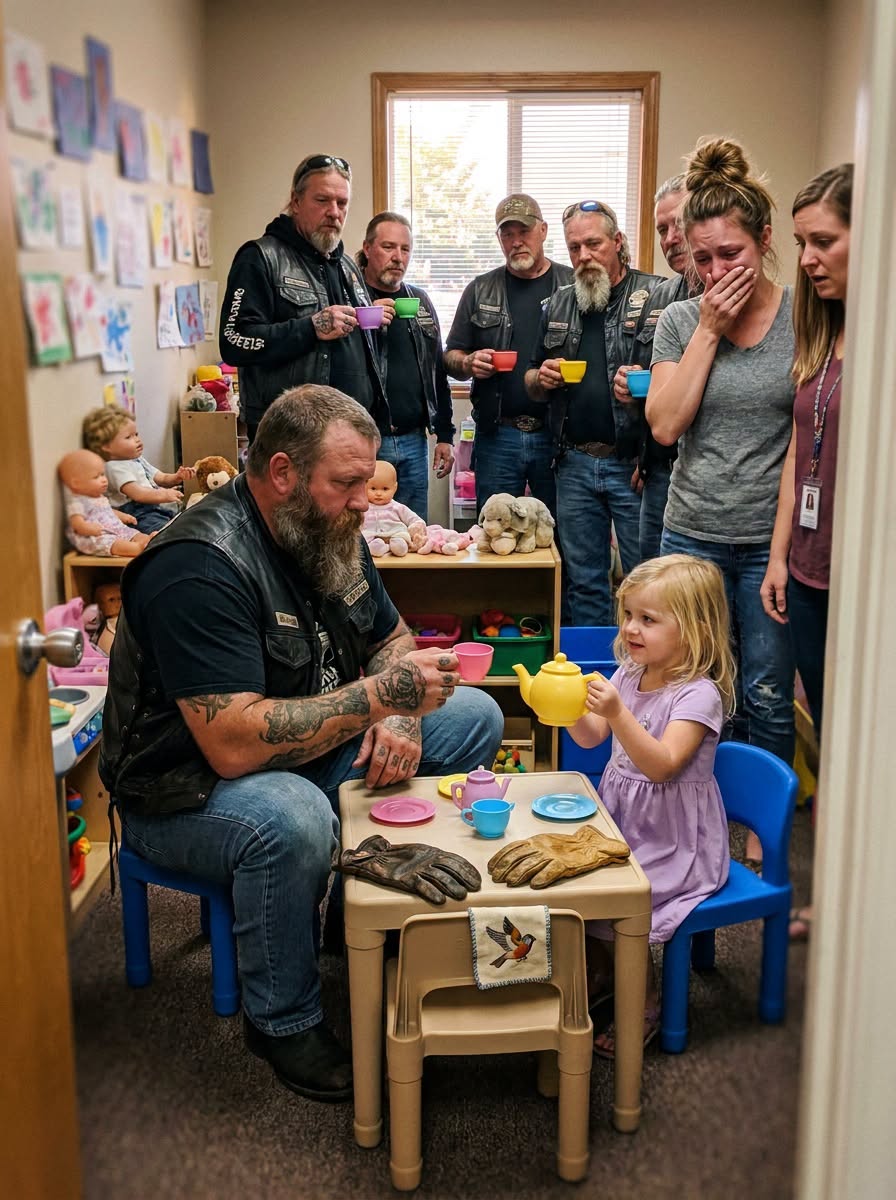
At the front was Walter Maddox. People called him Bear, and the name fit the way a good nickname does: not clever, just true. Six-four, silver beard, shaved head, the careful slowness of a man who has learned that his size can frighten people before he opens his mouth. Under one arm, his helmet. In the other hand, a pink plastic teacup.
That was when I saw the rest.
Every one of them carried a cup.
Blue. Purple. Yellow. Green. Tiny things meant for dolls, ridiculous in hands mapped with oil and old scars.
Inside, Lily Harper sat alone at the little round table.
She had set three stuffed animals, two dolls, and one empty chair. The dolls wore paper crowns she had cut that morning. The teddy bear had a napkin tied around its neck like a gentleman who had somewhere important to be. A plastic teapot waited in the center, as if patience were a thing a teapot could practice.
That morning she had asked, very quietly, if we could have a tea party.
I said yes.
Then she whispered, “But nobody comes to mine anymore.”
Her father, Daniel, had been dead seven weeks. A motorcycle, a wet road, the kind of ordinary accident that still manages to feel like theft. He had been new to the club and old in the habit of arriving ten minutes early for pickup because Lily hated being the last child waiting by the door. After the funeral she came back smaller somehow. She drew motorcycles with wings. She set extra chairs. She asked the questions adults fail in public.
Does Daddy still know my birthday?
Can heaven see tea parties?
If Daddy can’t come, does that mean nobody comes?
Her mother had signed the permission slip that morning after Walter called. Sarah could not leave work. Grief had made her attendance fragile, and she was one missed shift from losing the job that still paid the rent. But she had said, if they meant it, Lily would remember.
None of us were ready for the hallway.
Twenty of them, moving past cubbies and finger-paint suns, each holding a toy teacup as if it were something that could break.
Denise met them at the office. She looked at their faces the way a principal looks at weather she cannot control. Walter took off his sunglasses.
“We’re here for Lily Harper’s tea party, ma’am.”
The classroom door opened.
Lily looked up.
For one long second the room was wrong: all that leather and height against tiny chairs, all that road-worn silence against construction-paper crowns. The air seemed to hold its breath with her.
Then Walter lowered himself. His knees made a sound like old wood. He held up the pink cup as if presenting it to a queen who had not yet decided whether the court was real.
“Miss Lily,” he said, and his voice was quieter than the engines had been. “We heard the royal tea table had empty seats.”
She did not speak.
She only looked at the empty chair she had set that morning, then at the twenty cups in twenty enormous hands, and something in her face—something that had been folded carefully shut since the funeral—began, very slowly, to unfold.