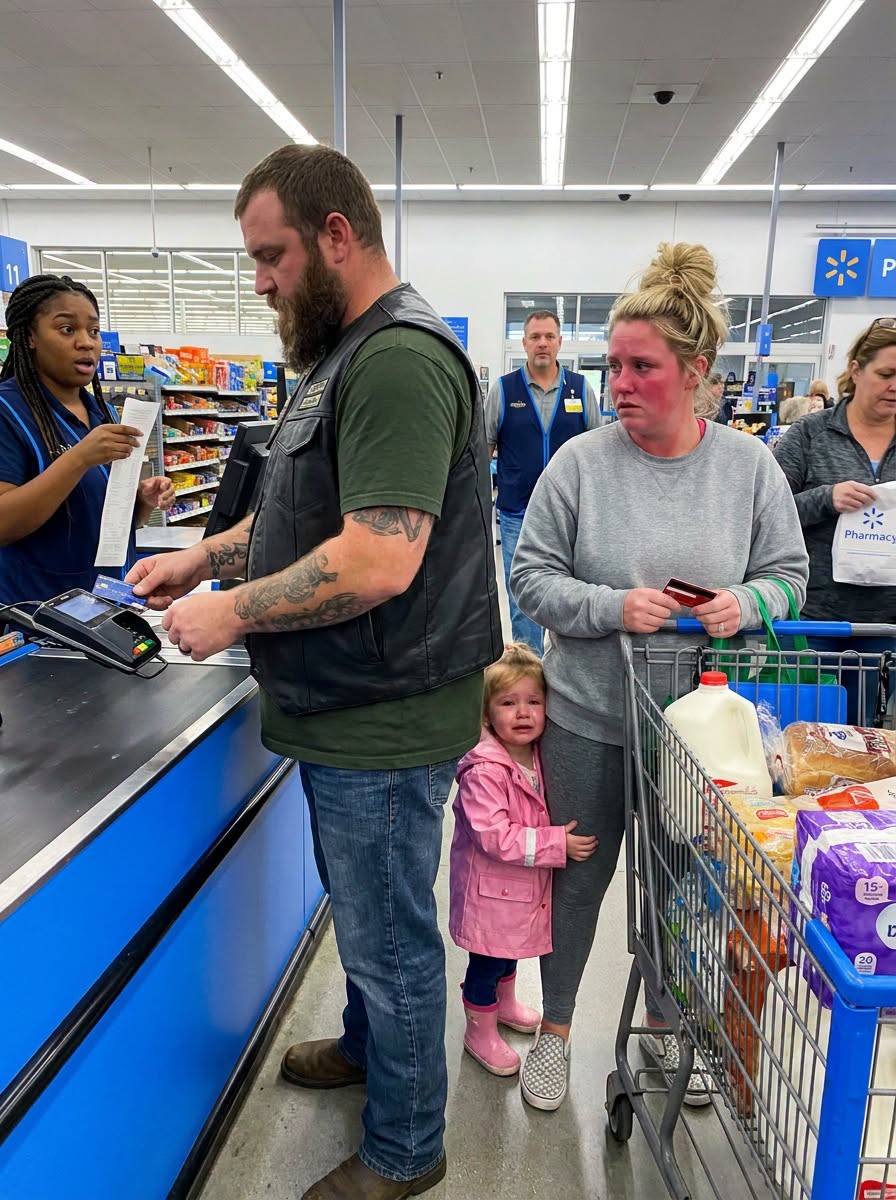
PART 2 – People Judged the Biker for Offering Candy to a Crying Child. They Went Silent When He Paid for the Groceries Her Mother Couldn’t—and Walked Out With Almost Nothing Left of His Own.
Emily did not move.
The bags sat on the counter like evidence. Mia held the side of the cart with both hands, no longer asking for candy, only watching her mother’s face as if it were a weather report she had not been taught to read.
“I didn’t ask,” Emily said, to me, to the air, to the place where he had been standing.
“I know.”
The man behind her made a sound of impatience that had missed the point by a mile. I bagged what was left, slid the receipt toward Emily, and watched her stare at the total as if generosity were a debt that might collect interest before she reached the car.
“He can’t just—”
She stopped. People who have been refused by machines do not always have language for being saved by a stranger.
Outside, the automatic doors breathed open and shut. I saw him cross the lot under the hard white lights, not hurrying, bread and oil still in the crook of his arm. He did not look back. Heroes in movies look back. Men who have decided a thing is finished usually do not.
Rafael appeared at my shoulder.
“You see his face when the second card died?”
“I saw it.”
“That wasn’t charity face,” he said. “That was recognition.”
I called for a relief cashier. I told myself it was because the line had gone strange and someone ought to make sure the woman got to her car. The truth was simpler. I wanted to know whether the night had really let him leave.
The lot was wet from an earlier rain that had not quite committed. Carts stood abandoned in the painted lines like unfinished sentences. Emily was still inside, kneeling now to zip Mia’s raincoat, performing the small recoveries mothers do when the world has just been both cruel and kind in the same five minutes.
He was at a bike near the far lamp.
Not unlocking it.
Standing there with his own basket of almost nothing, looking at a phone screen the way Emily had looked at mine.
I should have gone back in.
I didn’t.
He did not notice me until my shoes hit a puddle and the sound gave me away. Up close he was younger around the eyes than the leather suggested, and tireder than the calm had admitted.
“Store’s fine,” I said, which was a foolish opening and the only one I had. “She got out with everything.”
He nodded once.
“Good.”
“She’ll come looking for you.”
“She shouldn’t.”
The phone in his hand dimmed, then lit again. I was not close enough to read it, only close enough to see the shape of a past-due notice pretending to be a message. He locked the screen with his thumb as if privacy were a muscle he still had.
“You didn’t have to do that,” I said.
He glanced toward the doors, where Emily’s figure had not yet appeared.
“I know what a no is worth,” he said. “People offer the candy because it’s easy to be the good guy for two dollars. The rest is the part that follows you home.”
He set the bread and oil on the seat. For a second I thought he would swing on and vanish into the wet dark, story complete, moral intact.
Then he took out his wallet.
Not to show me anything.
To look, briefly, at what was left after the number he had just covered.
The look lasted less than a breath.
It was enough.
Behind us the doors opened. Mia’s light-up sneakers flashed across the concrete, a tiny constellation arriving too fast. Emily’s voice came after her, stretched thin with thanks she had not yet chosen words for.
He heard them.
He put the wallet away.
And that was when his phone buzzed again—hard, insistent, the kind of call that does not care what a man has just done for a stranger—and the name on the screen made his whole body go still in a way the declined cards had not.
TO BE CONTINUE…