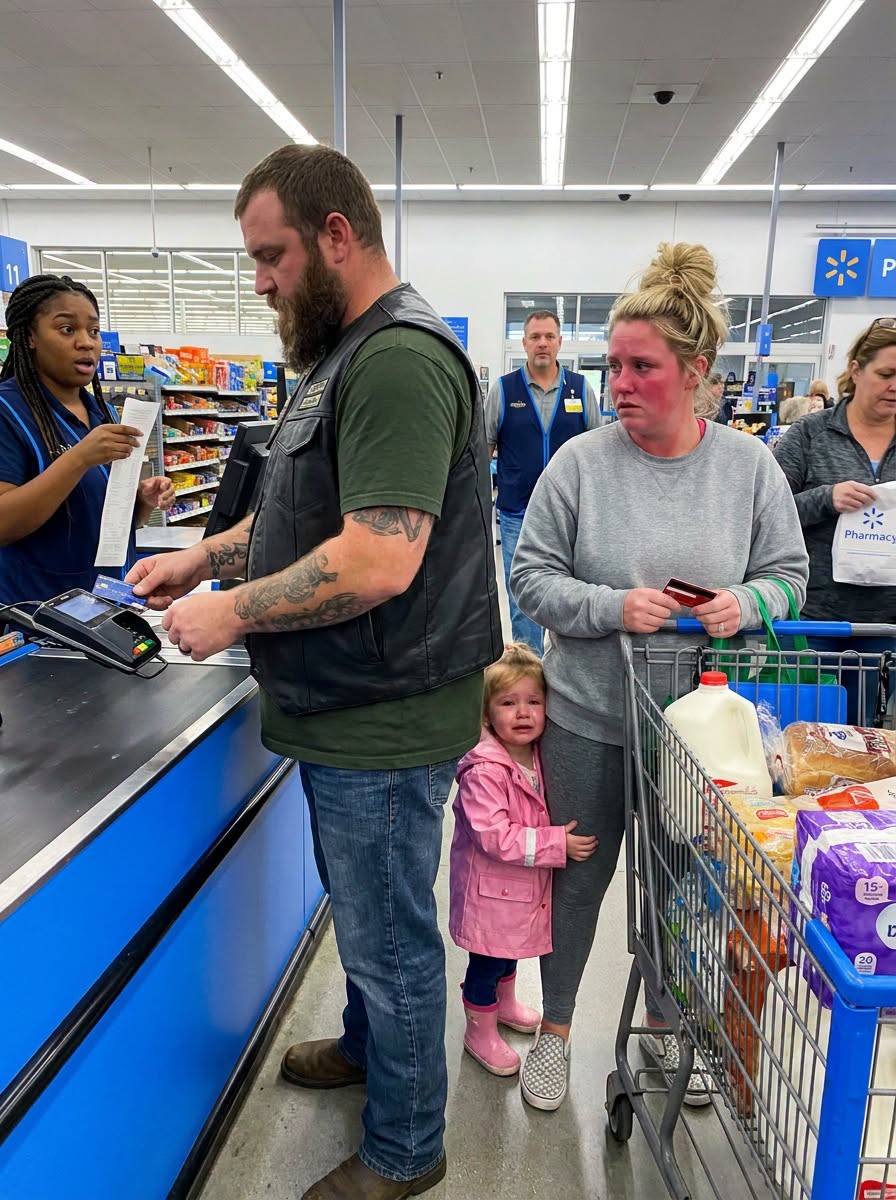
People Judged the Biker for Offering Candy to a Crying Child. They Went Silent When He Paid for the Groceries Her Mother Couldn’t—and Walked Out With Almost Nothing Left of His Own.
Wednesday night at the grocery store had the sound of people trying not to come apart in public.
Cart wheels stuttered over old tile. Scanners chirped. A freezer door sealed with a tired sigh. Somewhere near produce a child was already negotiating the price of being four. I was on register seven, far enough into the shift that my feet had opinions and my face had learned to stay neutral.
I heard the mother before I saw her.
Not shouting. The other sound. The one that happens when a voice has been careful all day and is beginning to fray at the edges.
“Please, Mommy.”
“No, Mia.”
“Just one.”
“No.”
“Mama, please.”
Emily Thompson stood at the candy shelf as if it were a test she had already failed in private. Blond hair knotted up without ceremony. Sweatshirt that had seen too many washes. A face held together by arithmetic. Beside her, Mia—four, pink raincoat still on indoors, light-up sneakers blinking with every frustrated step—wanted gummy bears with the total sincerity of a heart that had not yet learned the difference between desire and disaster.
“No, baby.”
The word baby was love. The word no was rent, gas, the medicine already in the cart, the quiet panic of a total she had not yet seen.
A man behind them rolled his eyes as if parenting were a performance he had paid to dislike. Rafael, restocking gum, slowed for no professional reason and became extremely interested in a display that did not need him.
Then the biker stopped.
He looked like the kind of man people decide against in a single glance: height, leather, shaved head, ink climbing out of his sleeves, a loaf of bread and a bottle of oil tucked against his forearm as if even kindness had to share space with ordinary errands. His vest said nothing. No club name. No invitation to speculate.
He did not crowd her.
“Ma’am,” he said, low enough that the aisle did not get to keep the sentence. “Can I buy the candy for her?”
Emily turned as if generosity itself had embarrassed her.
“No.”
He nodded.
No smile to soften it. No second try dressed as charm.
“She can’t learn that crying gets rewarded.”
“I understand.”
Mia wept into her sleeve. He crouched, but not close. The distance was a kind of manners.
“Your mama said no,” he told the girl. “She’s the boss.”
Then he stood and walked away.
That was why I remembered him.
Not the offer.
The acceptance.
He did not wink at the child. He did not slip a bag into the cart like a secret hero. He did not make a mother look cruel for doing the harder thing in front of strangers. He took the boundary as seriously as the tears and moved on.
Ten minutes later Emily reached my belt.
Mia had passed from wailing into that small, hiccuping sorrow children wear when they are tired of being disappointed and have not yet found a new reason. Milk. Bread. Bananas. Chicken. Rice. Cereal. A box of medicine. Detergent. Diapers. The groceries of a life that was still trying.
She watched the screen the way people watch weather they cannot afford.
One hundred eighty-seven twenty-six.
Card.
Declined.
Again.
Declined.
“I’m sorry,” she whispered to me, as if the machine’s refusal were a personal failure she owed the store an apology for.
Second card.
Declined.
The line behind her changed temperature. A man exhaled like the delay had been designed for him. Mia looked up, saw her mother’s face, and began to cry again—not for sugar this time. For the look. Children learn that look early. It means the floor has moved and the grown-up cannot say so.
Emily reached for the detergent first.
“I can put some things back.”
Her voice almost made it.
That was when he left his place in line.
No speech. No audience-seeking pause. He came to the reader as if paying were simply the next necessary motion, like setting a kickstand or checking a mirror.
“Sir,” I said. “Are you covering it?”
He nodded.
Emily shook her head hard enough that it looked like fear wearing pride.
“No. Please. I can’t let you.”
He looked at her the way a person looks at someone who has already said no once and meant it.
“I know you told me no about the candy.”
She went still.
“So I’m not buying candy.”
The receipt unspooled between us, thin and final.
He glanced at Mia, then back at her mother, and spoke as if the child were both present and, for this one sentence, safely outside the math.
“I’m paying for the part she’s too little to understand.”
By the time Emily understood the shape of what he had done, he was already walking toward the automatic doors.
And nobody in that line knew the night was not finished with him yet.