A HEART-WRENCHING MOMENT WHERE DUTY AND HUMAN NATURE COLLIDE UNDER THE POURING RAIN
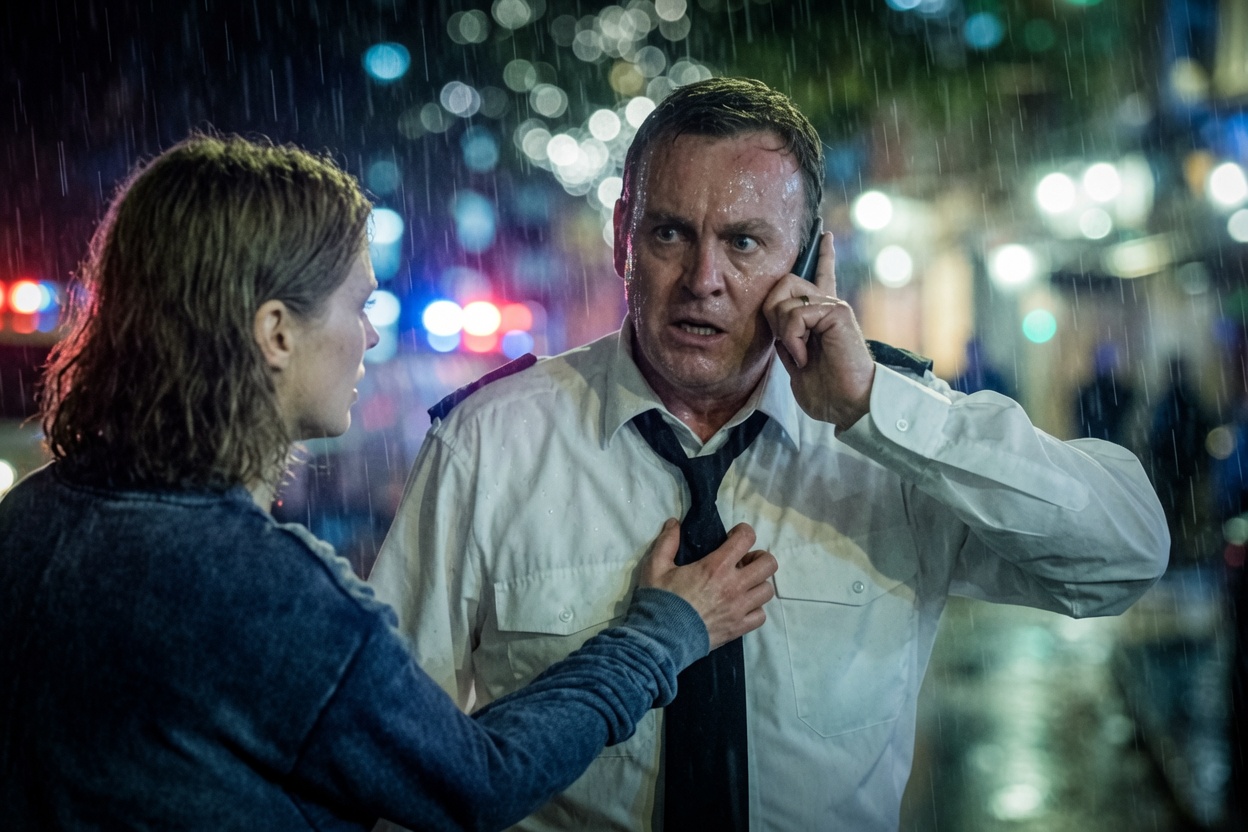
Philip Glenister as David Murdoch and MyAnna Buring as Jules Hope in a pivotal rain-soaked confrontation from Prey Series 2. The image perfectly encapsulates the collision of duty, fear, and impossible choices.

Prey Season 2, which aired in 2015, follows Prison Officer David Murdoch (Glenister), a dedicated public servant whose life unravels in the space of a single phone call. When his pregnant daughter Lucy is kidnapped, Murdoch receives devastating instructions: facilitate the escape of inmate Jules Hope (Buring) or lose his child forever. What begins as a straightforward—if terrifying—act of coercion spirals into a high-stakes manhunt across Manchester and beyond.
Glenister, best known for his charismatic yet authoritative roles like DCI Gene Hunt in Life on Mars and Ashes to Ashes, brings a grounded everyman quality to Murdoch. In this scene, we see him not as a larger-than-life hero but as a father stripped bare. His uniform—typically a symbol of order and control—is rendered pathetic by the rain, clinging transparently to his frame. The phone pressed to his ear likely carries the voice of the kidnapper or a desperate update, forcing him to balance the immediate threat against the woman standing before him.
MyAnna Buring, whose career spans intense roles in The Witcher, Ripper Street, and Banished, portrays Jules with a compelling mix of vulnerability and steel. As the convict entangled in Murdoch’s nightmare, she represents both the catalyst for his downfall and, potentially, his unlikely ally. Her outstretched hand in the image suggests a pivotal exchange—perhaps an attempt to calm him, warn him, or pull him deeper into the chaos. The rain-soaked setting amplifies their isolation; even in a bustling city, they are utterly alone with their choices.
Themes of Duty, Family, and Moral Gray Areas
The power of this image—and the series it comes from—lies in its refusal to offer easy answers. Murdoch is a man defined by duty: to his job, to the law, to his family. Yet the kidnapping forces a brutal hierarchy. How does one weigh the abstract rules of society against the visceral reality of a daughter’s life? The pouring rain serves as a perfect metaphor—unstoppable, blurring boundaries, washing away certainties.
British crime dramas have long excelled at this kind of intimate psychological pressure cooker, from Line of Duty to The Responder. Prey distinguishes itself by centering the personal stakes so viscerally. Viewers aren’t just watching a chase; they’re inhabiting the suffocating dilemma of a father who knows that complying makes him a criminal, but refusing might make him a grieving parent.
The scene’s nighttime urban setting, with its blurred lights and relentless precipitation, heightens the emotional realism. Rain in British television is rarely just weather—it’s emotional punctuation. Here, it mirrors the characters’ inner turmoil: cold, relentless, soaking through every defense. Glenister’s furrowed brow and Buring’s intense gaze convey volumes without dialogue. One can almost hear the distant sirens, the patter of rain on pavement, and the pounding of hearts caught in an impossible bind.
Acting Craft and Directorial Choices
Philip Glenister’s performance in Prey Season 2 was widely praised for its physicality and emotional depth. In interviews around the release, he described the role as high-octane, drawing comparisons to films like The Fugitive and Harrison Ford’s Frantic. The physical demands—fleeing through rain-lashed streets, maintaining tension in prolonged confrontations—required an actor who could convey quiet desperation as powerfully as explosive action.
Buring matches him beat for beat. Jules is no mere plot device; she’s a complex character with her own motivations and traumas. Their chemistry crackles in this frame—the power dynamic shifting moment by moment between captor/captive, officer/inmate, man/woman, father/ally. Director Lewis Arnold’s choice to film in such adverse conditions pays off tremendously. The wet surfaces reflect light dramatically, creating a noir-ish atmosphere that feels both cinematic and painfully real.
Cinematographically, the shallow depth of field isolates the pair against the glowing city backdrop. The bokeh effect transforms ordinary streetlights into ethereal halos, suggesting a world of warmth and safety that is tantalizingly out of reach. This visual language underscores the theme: even surrounded by society, personal crises render everything else peripheral.
Broader Context: Why This Moment Resonates
In an era of streaming content saturated with spectacle, scenes like this remind us of the enduring power of character-driven storytelling. Prey Season 2 doesn’t rely solely on car chases or gunfights (though it has those); its heart is in moments of quiet devastation like the one depicted. It explores how ordinary people—good people—can be pushed to the edge.
The series taps into universal fears: the vulnerability of family, the fragility of the systems we trust to protect us, and the terrifying speed with which life can upend. For parents, the idea of choosing between duty and a child’s safety is a nightmare scenario. For those in positions of authority (police, prison officers, first responders), it raises uncomfortable questions about where personal loyalty ends and professional obligation begins.
This image has circulated among fans precisely because it crystallizes these tensions so effectively. It invites viewers to pause and reflect: What would I do in that moment? Would the uniform hold, or would humanity win out? There is no clear “right” answer, and that ambiguity is what makes mature storytelling so profound.
The Legacy of Prey and British Crime Drama
Prey was an anthology series, with Season 1 starring John Simm in a similar high-concept premise. Season 2’s shift to Glenister and Buring kept the format fresh while maintaining the core thrill of the innocent (or semi-innocent) on the run. Its critical and audience reception highlighted the strength of ITV’s drama output during that period, blending accessible entertainment with deeper thematic resonance.
Today, with the show finding new life on streaming platforms like Netflix, new generations are discovering these characters. The rain-soaked confrontation between Murdoch and Jules continues to spark discussions about ethics, performance, and the craft of television. It stands as a testament to how a single, well-composed frame can encapsulate an entire narrative’s emotional core.
Reflections on Human Vulnerability
Ultimately, this scene is a meditation on the limits of control. No amount of training, no uniform, no promise of duty can fully prepare someone for the moment when the personal and professional collide so catastrophically. The rain washes away pretenses, leaving only raw humanity: a father’s fear, a woman’s complicated agency, and the desperate search for any path forward that doesn’t end in total loss.
In Glenister and Buring’s capable hands, what could have been a standard thriller trope becomes something far more memorable—a heart-wrenching portrait of people doing their best in the worst circumstances. It reminds us that true drama isn’t about superheroes or infallible institutions, but about flawed individuals navigating the gray zones where rules meet reality.
As the rain continues to fall in that frozen moment, we are left not with resolution, but with empathy. Life’s hardest choices rarely come with clear skies or easy answers. Sometimes, they arrive in the pouring rain, phone in hand, with everything you value hanging in the balance.