NETFLIX PRESENTS A MASTERCLASS IN SUSPENSE, POWER DYNAMICS, AND UNTOLD SECRETS
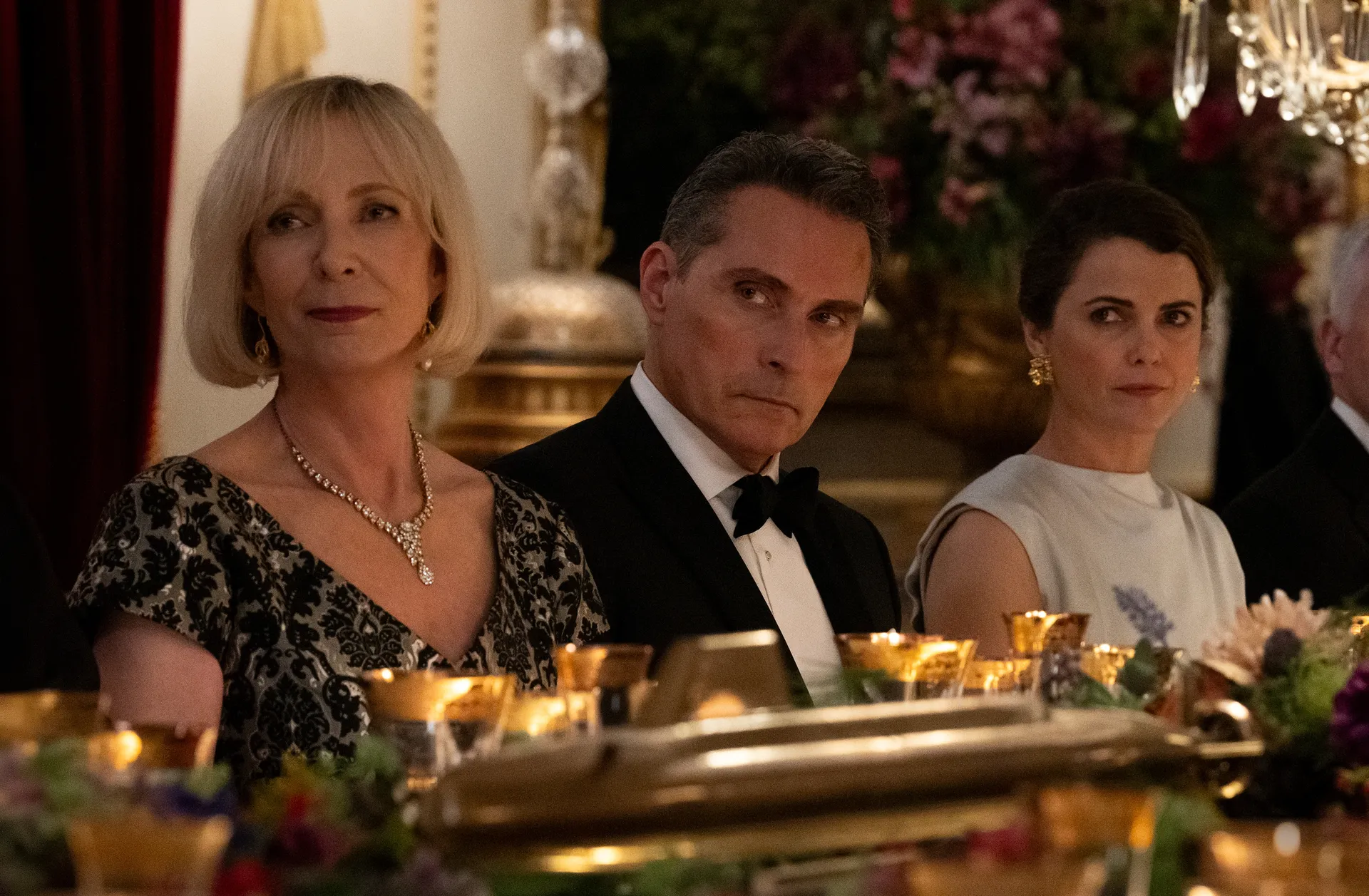
High politics, hidden motives, and a battle for the White House. On Netflix, this critically acclaimed series spotlights Allison Janney alongside Keri Russell in a deadly game of leverage. The whisper Hal receives from a foreign contact right in the middle of dinner proves that in the world of The Diplomat, no conversation is ever just dinner conversation.
In an era when real-world diplomacy often feels like performance art staged for cable news, Debora Cahn’s The Diplomat delivers something rarer: the sensation that you are watching the actual machinery of power grind, spark, and occasionally explode. The series, which premiered in 2023 and has grown sharper and more ruthless with each season, has become Netflix’s premier political thriller—a show that treats the corridors of embassies and the private dining rooms of the powerful with the same meticulous tension that other series reserve for bank heists or serial killers.
At its center stands Kate Wyler, played with ferocious intelligence and barely contained exhaustion by Keri Russell. A career foreign-service officer who never sought the spotlight, Kate is thrust into the role of U.S. Ambassador to the United Kingdom amid an international crisis that threatens to unravel alliances older than most of the people managing them. Russell plays her as a woman who is brilliant at crisis and allergic to ceremony, someone who would rather negotiate in a secure room than smile for cameras on a red carpet. The performance has earned widespread acclaim precisely because it refuses glamour. Kate’s strength is not invulnerability; it is the ability to keep functioning while everything around her—including her marriage—is coming apart.
Opposite her, and frequently against her, is her husband Hal Wyler, portrayed by Rufus Sewell with a mixture of charm, arrogance, and genuine strategic genius that makes him impossible to dismiss. Hal is the classic operator: the man who knows everyone, who can extract a crucial piece of information over a glass of wine, and who believes that the rules are more flexible for people who understand them better than the people who wrote them. Their marriage is the series’ emotional and thematic core—a long, complicated partnership between two people who love each other, respect each other’s minds, and repeatedly damage one another in the service of ambition or principle or both.
Into this already combustible dynamic steps Allison Janney as Grace Penn. First appearing as Vice President and later ascending to the presidency, Janney’s Grace is a study in controlled power. She is not the warm, empathetic leader of political fantasy. She is calculating, experienced, and fully aware that the highest office in the land is also the most isolated. Janney, reuniting with West Wing colleagues in spirit and sometimes in casting, brings a steely authority that shifts the entire temperature of the show. When Grace and Kate share a scene, the air changes. Two exceptionally capable women, both accustomed to being the smartest person in the room, size each other up while the fate of alliances and careers hangs in the balance.
The series thrives on the accumulation of small, irreversible moments. A conversation that should have stayed private. A decision made in the heat of crisis that cannot be walked back. A piece of intelligence delivered at exactly the wrong—or right—time. The promotional tease that has circulated around the show—“the whisper Hal receives from a foreign contact right in the middle of dinner”—captures the essence of how The Diplomat operates. Information does not arrive in clean briefings. It arrives mid-course, under the clink of silverware, while the people who need to hear it are performing the rituals of statecraft. One quiet sentence can recalibrate an entire strategy. One look across a table can reveal that the person you thought was your ally has already chosen a different side.
Cahn, who cut her teeth on The West Wing and Homeland, understands that the real drama of high politics is rarely the public speech. It is the private calculation that precedes it. The Diplomat is packed with the kind of procedural detail that rewards attention: the difference between an official channel and an unofficial one, the weight of a secure phone call versus an off-the-record conversation, the way a single piece of leverage can be used, withheld, or weaponized. The show never lectures. It simply lets the consequences play out.
What elevates the series beyond competent political drama is its refusal to simplify the characters. Kate is neither pure idealist nor cynical operator. Hal is neither pure villain nor misunderstood genius. Grace Penn is neither savior nor monster. They are professionals who have spent decades learning how power works, and who now find themselves testing the limits of what that power can justify. Their personal relationships—marriages, rivalries, fragile alliances—are not subplots. They are the main stage on which the larger geopolitical questions are acted out.
The show has been renewed through a fourth season, with Janney and Bradley Whitford (as Grace’s husband, Todd Penn) elevated to series regulars. Production on the new episodes wrapped in mid-2026, and Netflix has positioned the season for a late-2026 release, with industry tracking pointing toward a fall or early winter arrival. Until then, the existing seasons remain available in full on the platform. Viewers can start from the beginning or dive into the later installments, though the cumulative force of the series rewards sequential viewing. The power dynamics deepen. The secrets compound. The cost of every maneuver becomes clearer.
Critics have praised the writing for its precision and the performances for their refusal to soften the characters’ edges. Russell’s Kate is particularly compelling because she never stops being competent even when she is unraveling. Janney’s Grace brings a different kind of gravity—the authority of someone who has already paid the price of ambition and is prepared to extract more. Together they create a portrait of women navigating institutions designed by and for men, institutions that still demand they perform certain versions of themselves while punishing them for any deviation.
Yet The Diplomat is not primarily a story about gender, though gender is never irrelevant. It is a story about leverage. Who has it. Who thinks they have it. Who is willing to use it, and at what cost. The dinner table becomes a battlefield. The whispered confidence becomes a loaded weapon. The foreign contact is never simply a source of information; he or she is a vector for consequences that will travel far beyond the room.
In a media landscape crowded with political content that either moralizes or sensationalizes, The Diplomat occupies a more interesting space. It is interested in the mechanics. It is interested in the human beings operating those mechanics under pressure. And it is interested in the moments when the two collide—when a quiet word spoken over dinner changes the trajectory of careers, marriages, and possibly nations.
All seasons currently available stream exclusively on Netflix. Season 4 is scheduled to arrive later in 2026. Until then, the existing episodes offer a masterclass in how suspense is built not through explosions alone, but through the careful accumulation of secrets, the shifting balance of power, and the knowledge that in this world, someone is always listening—and someone is always deciding what to do with what they hear.
The whisper has already been delivered. The only question left is what happens next.