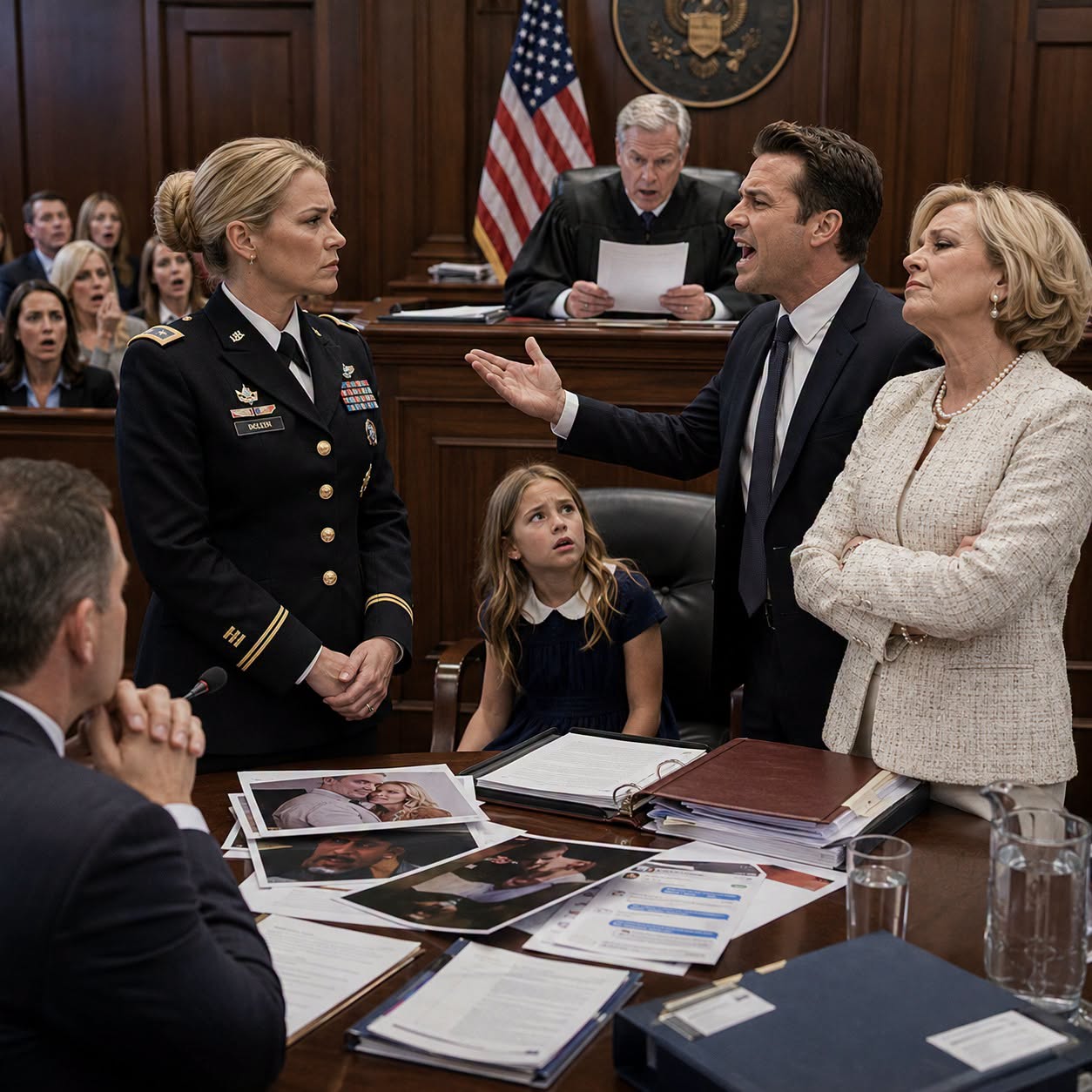
In the sterile hush of the courtroom, my husband leaned forward and delivered the line he had rehearsed like a verdict: “Combat made her dangerous.”
Garrett’s voice carried the quiet certainty of a man who believed his own myth. Beside him, his mother, Evelyn, allowed herself the smallest smile, her gaze sliding over my crisp dress uniform as though it were already a relic. They wanted everything—our seven-year-old daughter, the house that still carried the scent of Lily’s crayons, and the $3.2 million estate I had forged from discipline, sacrifice, and the inheritance my father left me. I sat motionless while their lawyer paraded forged messages and painted me as a fractured shadow of a mother. Then the judge unsealed my classified military file, scanned a single page, and posed one quiet question to Garrett. The color drained from my husband’s face like blood from an open wound.
“Sign the papers, Diana,” Garrett said from the same sofa where we had unwrapped Christmas gifts only six months earlier, Lily’s laughter still echoing faintly in the walls. “Or we’ll have to tell the judge you’re too damaged to be near your own daughter.”
He didn’t shout. Men like Garrett rarely needed to. His calm was a weapon, honed by years of charming boardrooms and golf courses while I shipped out to places the world preferred to forget.
Evelyn sat beside him, one elegant ankle crossed over the other, her pearl earrings catching the lamplight. She looked as if she had already redecorated my living room in her mind. A lawyer in a tailored gray suit occupied my favorite reading chair—Malcolm Reed, according to the embossed card he finally slid across the coffee table. His polished shoes reflected the ceiling fan turning lazily overhead.
“Where’s Lily?” I asked, keeping my voice even.
“Upstairs,” Garrett replied, pushing a thick sheaf of documents toward me. “Pack what you need. Leave quietly. This doesn’t have to be ugly.”
The top page read Petition for Dissolution of Marriage. The next demanded sole custody of our daughter. Then came the financial assault: my investment accounts, my military retirement, the family trust—everything I had built with the precision of a soldier who understood that survival often came down to numbers and preparation.
Evelyn tapped a manicured nail against the custody papers. “Combat changed you, dear. You’re cold now. Detached. Unpredictable. Lily needs stability. A normal home.”
I set my small suitcase down. One wheel clicked against the hardwood like a metronome counting the death of something sacred.
“I was gone three days,” I said.
Garrett leaned back, steepling his fingers. “And we made excellent use of them.”
Malcolm cleared his throat and listed their evidence: neighbor statements, teacher concerns, whispers of PTSD, emotional volatility, and—most damning in their narrative—my access to weapons. Garrett placed a sleek pen atop the stack.
“Sign tonight, and I’ll allow supervised visits.”
Allow. The word lodged in my throat like shrapnel. I had carried Lily through nights of fever and heartbreak, through scraped knees and the terrifying first week of kindergarten when she clung to my leg in the driveway. Garrett had missed her preschool graduation for a client’s golf trip in Scottsdale. Now he offered me permission to see my own child as though it were charity.
Evelyn studied my face, hungry for tears or rage. I gave her neither.
I rose and walked toward the stairs. Malcolm stood quickly. “Removing the child without agreement could constitute custodial interference, Mrs. Hargrove.”
I turned, meeting his eyes. “I’m going to kiss my daughter goodnight.”
No one followed.
Lily sat cross-legged on her bed, headphones on, the glow of her tablet painting her face in soft blues. The room smelled of strawberry shampoo and the half-eaten grilled cheese she had abandoned on the nightstand. When she saw me, her whole being lit up.
“Mom!” She launched herself into my arms. I held her fiercely, then forced myself to loosen my grip before anyone downstairs could weaponize the moment.
“Are you staying home now?” she whispered against my shoulder.
I glanced at the glitter stars we had stuck to the ceiling together on a happier night. “I’m staying close, sweetheart. Always.”
Her backpack was already packed and waiting by the door. The sight of it carved something deep inside me. This betrayal had roots older than three days.
Downstairs, Garrett waited near the kitchen island, the refrigerator humming its indifferent lullaby. A faint coffee stain ringed his mug—normal life intruding on nightmare.
“You’re frightening her,” he said.
“No,” I replied softly. “You are.”
His expression hardened into something colder. “You have no idea what I’ve prepared.”
He showed me his phone. Screenshots of messages—threats, raw confessions of nightmares, admissions of losing control. The grammar was mine. The timestamps matched my deployments. They were masterful forgeries, close enough to sway a small-town judge.
“Where did you get these?” I asked, though I already suspected.
Evelyn materialized behind him like a shadow. “People tell the truth when they stop fearing you.”
They believed their own story. That was their weakness.
I snapped a discreet photo of the documents on the table. Garrett’s hand shot out, fingers clamping around my wrist hard enough to bruise bone.
“Don’t start collecting evidence,” he hissed.
Above the pantry door, the old security camera blinked its red eye. Garrett had installed it after a break-in years ago and promptly forgotten it recorded audio. I had not.
I pulled my wrist free without raising my voice. “Touch me again, and you’ll regret the angle.”
His gaze flicked toward the camera. Too late.
That night I slept in the guest room with a chair wedged beneath the doorknob. At 2:13 a.m., beneath the steady drum of rain, I heard them in the kitchen—voices low, conspiratorial.
“If she signs, the estate transfers before the audit,” Garrett murmured.
Evelyn’s reply was crisp. “Then make her sign. The bank is already asking questions.”
The house creaked around me, settling into the weight of secrets. Somewhere beyond the wet streets, a siren rose and faded like a dying breath. This wasn’t merely divorce. It was plunder.
By sunrise, Garrett had left for the office and Evelyn had spirited Lily off to school without a word to me. I drove to the quiet diner off Route 8, ordered black coffee, and opened my laptop in the corner booth. The waitress slid a plate of toast in front of me, one corner darkly burned.
“You look like you’ve been through hell, honey.”
“Busy week,” I said, offering a ghost of a smile.
I checked every account tied to my estate. Two unauthorized access attempts had been blocked—one from Garrett’s office IP, another routed through a wealth-management portal I had never authorized. Then I found it: a draft transfer request for $1.1 million bearing an electronic signature that was almost, but not quite, mine.
I called the bank’s fraud department. The representative’s tone shifted the moment I provided the transaction reference.
“Ma’am, this request is supported by collateral documentation.”
“What collateral?”
A pause stretched across the line. “A recorded deed and a marital asset agreement.”
I owned the house outright before I married Garrett. There had never been a marital asset agreement.
The forgeries had reached even here—deep, meticulous, and venomous.
My pulse remained steady, but something ancient and precise uncoiled within me: the same calm that had carried me through combat zones and impossible decisions. They had spent months building their trap. They had no idea they had just sprung it on themselves.
The judge’s chambers waited. And somewhere in my sealed file lay a single page that would change everything.
The diner’s fluorescent lights buzzed like distant artillery. I closed my laptop, left cash on the table, and drove through the gray morning with the kind of clarity that only comes when every illusion has finally burned away. Love had once made me patient. Marriage had made me blind. But war—war had taught me that survival isn’t about rage. It’s about choosing the exact moment to strike.
I didn’t go home. Instead, I went to the one place Garrett and Evelyn would never think to look: the modest office of Captain Laura Mendoza, my former JAG officer and the only person who still owed me a debt from a classified extraction in Kandahar. She listened without interruption as I laid out the forged messages, the unauthorized access attempts, the phantom marital agreement.
Laura’s eyes hardened. “They’re not just divorcing you, Diana. They’re trying to erase you.”
She made calls. Quiet ones. Within hours, I had digital timestamps proving the forgeries originated from Garrett’s laptop and a trail of bank logins that smelled of Evelyn’s private banker cousin. But the real weapon waited in my sealed personnel file—the one the court had requested and Garrett had foolishly agreed to unseal, believing it would only show “instability.”
I spent the afternoon in a cheap motel on the edge of town, reviewing every page of the financial documents I had photographed. Lily’s face kept surfacing in my mind: the way she had clung to me last night, the innocent hope in her voice when she asked if I was staying close. The thought of her waking up in Evelyn’s curated world—polished, cold, stripped of the fierce love I had fought to give her—ignited a slow, burning resolve.
By late afternoon, I stood outside the courthouse in my dress uniform, medals glinting like quiet accusations. Garrett and Evelyn arrived flanked by Malcolm, their expressions carefully arranged into concerned solemnity. Garrett even tried to touch my arm in the hallway, the picture of a worried husband.
“Diana, we can still settle this privately,” he murmured. “For Lily’s sake.”
I looked at him the way I once looked at enemy terrain—assessing every weakness. “You should have thought of Lily before you tried to sell her future.”
The hearing was closed. No press. Just the judge, a weary man named Harlan Whitaker with sharp eyes that had seen too many broken families, and the evidence laid bare on the long oak table.
Malcolm spoke first, painting me as a ghost who drifted in and out of Lily’s life, haunted by unseen demons. Neighbors testified to “strange silences” and “sudden departures.” Evelyn dabbed at dry eyes while describing how I had allegedly frightened Lily with “military discipline.” Garrett’s voice cracked at the perfect moment as he spoke of fearing for our daughter’s safety.
I sat perfectly still, hands folded, letting their performance unfold. Inside, I felt the old operational calm—the one that settles over you when the mission is no longer about survival but about justice.
Then it was my turn.
I didn’t cry. I didn’t accuse. I simply presented the chain of digital evidence, the security footage with audio of their midnight conversation about the audit, the mismatched signatures, the forged deed. Malcolm objected repeatedly, but Judge Whitaker’s expression had already begun to shift.
Finally, the judge turned to the thick manila folder that held my military record.
“I’ve reviewed the unsealed portions,” he said, adjusting his glasses. “Mrs. Hargrove served with distinction in multiple combat theaters. But there is one classified addendum here that counsel for the petitioner insisted on including, believing it would demonstrate instability.”
Garrett shifted in his seat. Evelyn’s smile faltered for the first time.
The judge opened the file, read silently for a long moment, then looked directly at my husband.
“Mr. Hargrove,” he said, his voice low and deliberate, “are you aware that your wife received the Distinguished Service Cross for actions that saved an entire platoon, including two embedded civilians, during an ambush where she was the only surviving officer?”
The color drained from Garrett’s face like sand through a broken hourglass. His mouth opened, but no sound came.
The judge continued, gaze unflinching. “And are you aware that the citation describes her as possessing ‘extraordinary composure under fire and unwavering moral clarity’—qualities you have spent this entire hearing attempting to redefine as mental instability?”
A heavy silence fell over the courtroom. Evelyn’s manicured hands tightened into fists. Malcolm stared at his notes as though they might offer salvation.
Judge Whitaker closed the file slowly, the soft thud echoing like a gavel.
But that was only the beginning.
The real storm was just arriving.
PART 3
The courtroom seemed to contract around Garrett’s silence. For the first time in years, he had no polished answer, no charming deflection. His mother’s mask cracked completely; Evelyn stared at the judge as though he had personally betrayed their carefully scripted future.
Judge Whitaker removed his glasses and rubbed the bridge of his nose, the weight of human frailty etched into every line of his face. “Mr. Hargrove, you came before this court accusing your wife of being unstable, dangerous, unfit. Yet the record before me tells a different story—one of a woman who walked through hell and chose, every single time, to come home to her daughter.”
He turned to me, his voice gentler now. “Mrs. Hargrove, I won’t pretend to understand the full cost of what you’ve carried. But I see a mother who has fought for her country and, far more quietly, for her child. The petition for sole custody is denied. Primary physical custody remains with you. The house stays in your name. The estate remains untouched.”
Malcolm tried one last desperate objection. The judge cut him off with a look.
“Furthermore,” Judge Whitaker continued, “this court finds sufficient evidence of fraud, forgery, and attempted financial exploitation to warrant a full investigation by both civil and criminal authorities. Mr. Reed, you will advise your clients accordingly.”
Garrett’s shoulders slumped. For a fleeting second, I almost felt sorry for the man I had once loved. Almost. Then I remembered Lily’s packed backpack, the forged signature on my money, and the casual way they had tried to auction off my life.
Evelyn rose on unsteady heels. “This is outrageous—”
“Sit down, Mrs. Hargrove,” the judge said sharply. “Or I’ll have you removed.”
The gavel fell.
Outside, the late afternoon light broke through the clouds for the first time that day. I stood on the courthouse steps, breathing air that tasted cleaner than it had in months. Laura waited at the bottom, arms crossed, a rare smile breaking across her face.
“You did it,” she said.
“We did it,” I corrected. “Now I get to go home to my daughter.”
Lily was waiting at Laura’s house, where I had arranged for her to stay during the hearing. When I walked through the door, she flew into my arms like a small missile of joy and strawberry shampoo. I held her without restraint this time, burying my face in her hair, letting the tears I had denied everyone else finally come.
“Mommy, are we safe now?” she whispered.
I pulled back just enough to meet her eyes—those bright, trusting eyes that had kept me alive through every deployment. “Yes, sweetheart. We’re safe. And we’re going to build something even better than before.”
That evening, as Lily slept curled against me on the sofa in our reclaimed home, I thought about the deeper truths this war at home had revealed. Combat had not made me dangerous. It had made me unbreakable. Betrayal had not destroyed me. It had stripped away everything false and left only what mattered: the fierce, quiet love of a mother who would walk through fire for her child.
Garrett and Evelyn would face consequences. The bank audit had already begun. Their carefully constructed lies were unraveling in the hands of investigators. But I would not waste my energy on hatred. I had a daughter to raise, a life to rebuild with intention, and a future that no longer belonged to anyone but us.
Some battles end with medals and citations. Others end with a little girl’s steady breathing and the soft glow of glitter stars on the ceiling. This one had given me both.
And for the first time in years, I slept without locking the door.
THE END