They Thought an Angry Father Would Come East and Hand Them the Story They Wanted. They Got Gate Footage, Hospital Photographs, and a Man Who Refused to Leave the Building Where His Child Could Still Say His Name.
The word Dad should not have to travel that far to reach a man.
It arrived wet and misshapen at 2:13 a.m., through the open window of a gray Honda with Kentucky plates, and then my daughter was falling toward the gravel as if the last eight hundred miles had used up the part of her that knew how to stand.
I caught her.
The gate camera blinked red above us. For once I was grateful for a lens.
“Hadley. Look at me.”
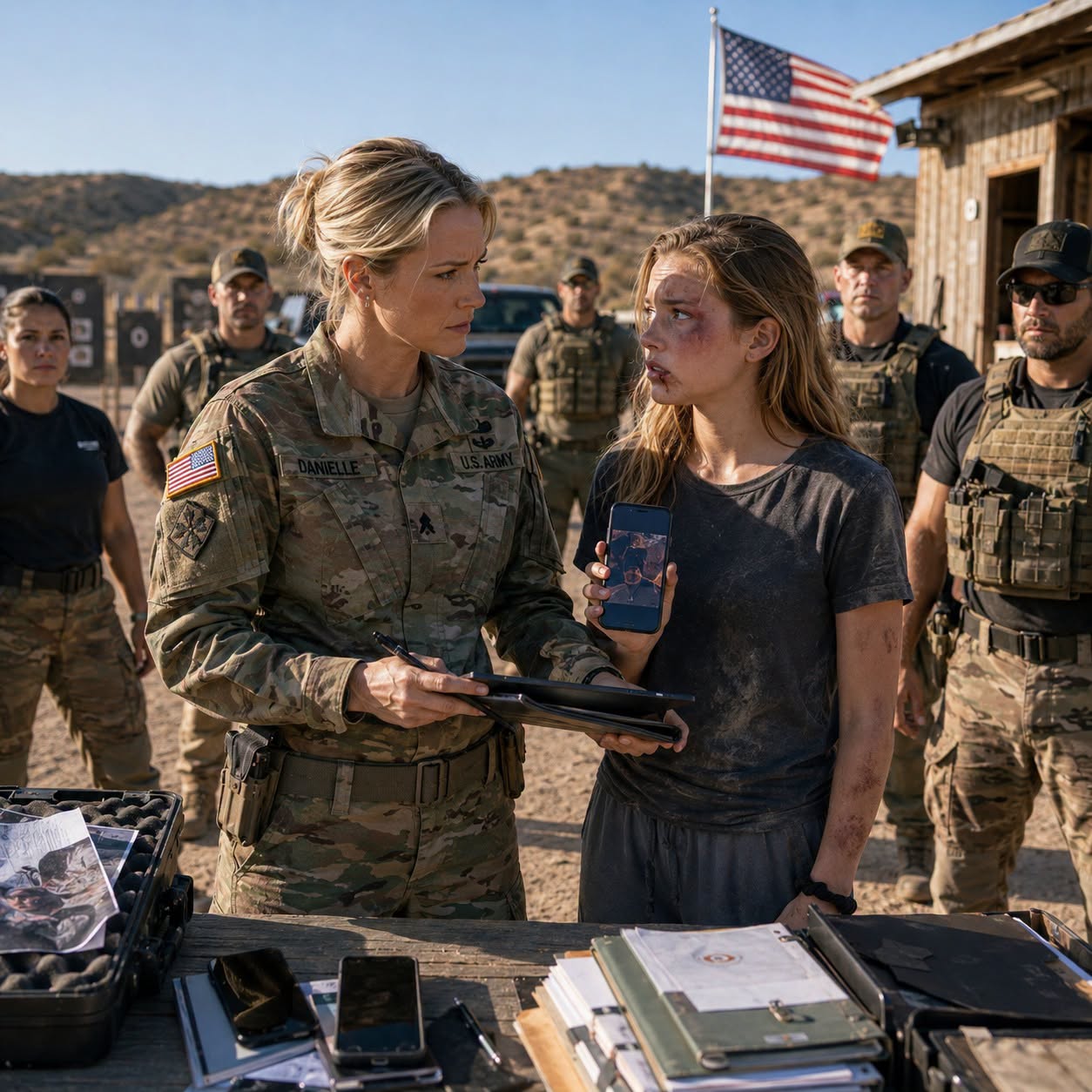
One eye had been taken by swelling. Finger-marks ringed her arms in a language I had spent twenty years teaching other people to recognize on strangers. She held her elbow against her ribs as if breath itself had become a negotiation. On the inside of her wrist, a circle. Deliberate. A cigarette had been used as punctuation.
I had trained units to keep their hands useful when a room went wrong. None of that training had a chapter for this.
“Who.”
She put a cheap cracked phone in my palm.
“Mom’s new family,” she whispered. “Eleven of them. They filmed it.”
My hands did not shake. That frightened me more than shaking would have. Shaking is human. Stillness is what a man uses when he is deciding whether to remain one.
“Are they behind you?”
“I don’t know.”
“Your other phone?”
“They took it.”
“Your mother?”
Hadley looked past me into the New Mexico dark, where the desert keeps its opinions to itself.
That was an answer.
I carried her into the gatehouse and called Aaron. I did not call the sheriff of a county I no longer trusted. I did not call Sandra. I did not press play. That last choice was the first one that kept me on the usable side of the night.
Aaron came in pajama pants and a medic’s jacket, the infirmary smelling of alcohol wipes and coffee that had given up. He asked the questions in a voice I could not have found. Pupils. Ribs. The burn. Tuesday. With my dad.
Outside, the flag over the training building snapped and snapped, a sound like someone trying to get a room’s attention.
I had not been her everyday father in eight years. A Kentucky judge had called my work unstable and my calendar unfit. Sandra had brought cookies to court. I had brought canceled weekends in columns. The cookies had a better lawyer.
She grew up on Garrity Ridge, where loyalty was discussed the way banks discuss vaults: often, and usually after something had gone missing. Sandra married Dane when Hadley was nine. Church polos. Fundraiser burgers. A towing yard, rentals, and a wilderness program the county paid by the head. His brother Brett kept the businesses that did not print well in the weekly paper. Conway, at the head of three Thanksgiving tables, liked to say family handles its own, and people laughed as if the sentence were folk wisdom instead of a warning label.
I had once watched a sheriff accept an envelope by a truck and been called paranoid for having eyes.
By morning Hadley was in Las Cruces with pictures taken by people whose job was not loyalty. Two ribs. A concussion. Burns that had required a thought. My attorney, Rachel, answered on the fourth ring and heard the calm in me the way bomb techs hear a ticking they do not like.
“Do not drive east. Do not call them. Do not write a single sentence you would not want a judge to read.”
“I know.”
“I’m saying it because you sound like a man who has already written the ending.”
She set filings in two states in motion. The Honda went behind a lock. The phone went into a bag I did not open. The gate video learned to live in more than one place.
The Garritys had filmed my child because they believed cameras were a family utility.
Hadley woke to a grilled cheese gone cold in foil and ate three bites like eating were a rumor. Then she talked, and the barn behind the ridge became a room I would have to enter without my boots on their soil.
Not a brawl that got out of hand. A business. Lights. A wall. A laptop. Men who owed money taught a lesson while other men watched from a distance money can travel. She had seen a face from town that was supposed to be in Ohio. She had told a cousin they had to go to someone with a badge. The cousin had told her the badge ate Sunday roast with Conway.
Someone heard.
Two nights later the barn had eleven people in it and my daughter in the middle. Some of them used their hands. Some of them used a lens. Dane stood in the doorway.
“He watched?”
She looked at the hospital blanket.
“I kept waiting for him to stop it.”
That sentence did more damage than I let my face admit.
“And your mother.”
“She said I shouldn’t have gone looking. She said family handles its own.”
The foil bag cried in my fist. I set it down before it became a different kind of evidence.
Cella had helped her leave. A sliver of recording. Cash. A phone. Then Cella had vanished into the only geography that family owned.
I stepped into the corridor and called Roman, who heard a diesel and then heard me, and understood the request before I dressed it: keep the range ordinary. Keep the logs honest. Keep my name on the property I actually occupied.
“They want you on the highway,” he said.
“I know.”
“You’re not going.”
“No.”
That was the second choice that kept me a father instead of a headline.
They thought they had built an angry man with a steering wheel and a destination.
They had built something slower.
In the room behind me, Hadley slept with her wrist bandaged and her mouth still trying, even in dreams, to say a word that would make a doorway move.
I stood under the fluorescent lights and did not watch the film.
Not yet.
The foundation of a house like theirs is never the barn.
It is the people who eat dinner after the barn goes dark, and call that peace.
TO BE CONTINUE…