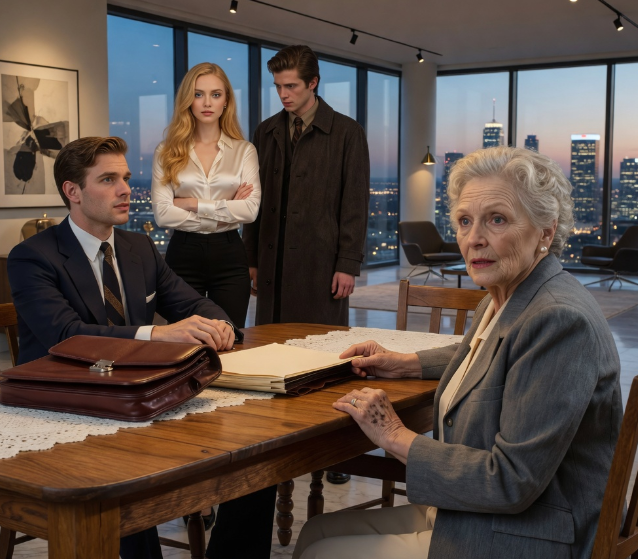
My son brought an attorney to my house on a quiet morning and called it protection. His wife stood in my living room
The Architect’s Ledger
My name is Margaret Carmichael, and I had just finished repotting a fern when my front door opened without a knock.
That was the first warning.
Not the bell. Not a gentle tap. The door simply opened, and my son Daniel walked in with his wife Renee and an attorney I had never met. Daniel did not hug me. That was the second warning. He stood in the entryway with his shoulders tight, wearing the face of a man who had already agreed to something and was hoping I would make it easy.
Renee looked around my living room slowly. The old mantel. Harold’s reading chair. The family photos. The stairs. The windows. She was not looking at my home like a daughter-in-law visiting a widow. She was looking at it like inventory.
The attorney stepped forward first. “Mrs. Carmichael,” he said, setting his briefcase on my dining room table, “this does not have to be difficult.”
Those words told me it already was.
His name was Evan Rourke. Young. Polished. Careful. The kind of man who knew how to make pressure sound like paperwork. He didn’t realize that the lace tablecloth he just placed his leather briefcase upon had been handmade by my grandmother, a woman who survived the Great Depression by knowing exactly how many beans were in the pantry and exactly who owed her a favor.
Daniel finally spoke. “Mom, we’re worried.”
Renee touched his arm, then looked at me with her softest expression—the one she usually reserved for cameras. “You live alone, Margaret. This house has stairs. The furnace is old. Daniel can’t keep wondering whether you’re safe.”
I still had soil beneath my fingernails. I felt the grit of the earth, a reminder of growth and survival. “I walked thirty minutes this morning,” I said quietly.
The attorney smiled politely. “That’s wonderful. But responsible planning is not about today. It’s about what may become difficult later.”
He opened a folder and slid papers toward me. Residential care brochures. Estimated home value. A trust proposal. A possible power-of-attorney arrangement. The entire rest of my life, reduced to pages they had prepared without asking me one honest question.
“And who would manage this trust?” I asked.
Daniel looked down. “I would,” he said. “With Renee helping. Just until things are settled.”
Just until.
There are phrases that sound harmless until you realize they are locks. Just until the house sells. Just until the money is managed. Just until your grief has been turned into a reason for other people to speak over you.
The Hidden Foundation
Three days earlier, I might have been shaken. Three days earlier, I might have poured coffee, sat down, and tried to prove I was still capable of owning my own life. I might have cried, wondering when my son had begun to see me as a liability rather than a mother.
But three days earlier, I had finally gathered the courage to clear out Harold’s desk.
Harold had been a municipal planner for forty years. He was a man of grids and blueprints, a man who loved crosswords and wore the same brand of bargain shoes for three decades. We lived a quiet, middle-class life. Or so I thought.
In the bottom drawer, behind a false back that only a man obsessed with structural integrity could design, I found a heavy manila envelope. Inside was a key, two business cards, and a letter.
“Margaret,” the letter began, in his precise, drafting-hand script. “If you are reading this, the world has become a smaller place for you. Don’t let them make it any smaller. You were always the foundation, My Love. I just provided the scaffolding.”
That letter took me to Claire Sutton at Meridian Asset Group. In a glass-walled office that smelled of expensive espresso and old money, I learned that my “bargain-shoe” husband had spent forty years quietly buying the very land he helped plan.
Commercial property. Investments. A storage facility outside Dayton. A savings account with a balance that made my vision blur. And one twelve-unit apartment building on Birchwood Drive in Cincinnati.
The building where Daniel and Renee had been living for four years.
They had told me they were “renting from a friend of a friend” at a “family discount.” In reality, they had been living in Harold’s—and now my—property. Their monthly checks, which they often complained about, had been flowing into a management account I now controlled.
The Table Turns
I pulled out the chair at the head of my dining table and sat. I didn’t wipe the soil from my hands. I wanted them to see the dirt. I wanted them to see the work.
“All right,” I said. “Show me what you brought.”
Evan Rourke smiled, thinking he had won the room. That was his mistake. He mistook my composure for concession.
I let him talk for twenty minutes. I let him use words like “liquidity,” “fiduciary responsibility,” and “sunset years.” I let Renee nod at the right moments, her eyes already measuring the windows for new curtains. I let Daniel stare at the table as though silence might keep him clean.
Then I reached beside my chair and lifted my own folder.
Thick cream paper. Blue tabs. Copies prepared by Claire Sutton. Notes reviewed by my own attorney, Robert Ellison—a man who had been practicing law since Evan Rourke was in diapers.
I placed it on the table. The sound was soft, a mere thud of paper on wood, but the room changed anyway. The air seemed to exit the space.
“Before I review your proposal,” I said, my voice steady, “I think everyone should understand the full financial picture.”
Evan’s smile tightened. “Of course, though informal records can be misleading.”
I opened the folder. “They can,” I said. “That’s why these are not informal.”
I slid the first page to Daniel. He picked it up with the uncertain look of a son humoring his mother. Then his face changed. His skin went from a healthy pink to a translucent grey. His eyes moved down the page, faster and faster, tracking the figures.
Renee leaned over. “What is it? Is it a debt?”
Daniel did not answer. He couldn’t.
She took the page from him. For the first time since she entered my house, Renee had no expression ready. The “inventory” she had been taking of my living room suddenly seemed like a child’s lemonade stand compared to the ledger in her hand.
I turned the second page toward the attorney.
“This is the deed history for Birchwood Drive,” I said. “The building was purchased by my husband nineteen years ago and passed directly to me through a survivor’s deed. It is held in a private LLC of which I am the sole member.”
Evan read. His hand stopped moving. The pen he had been clicking rhythmically fell silent.
“The building?” Daniel whispered.
I looked at him. “Yes.”
“Our building?”
“Yes. The one you’ve complained about. The one where you asked the ‘landlord’ for a new kitchen last summer? That was me, Daniel. I approved the granite countertops Renee wanted so badly.”
Renee sat down without meaning to. The predator had suddenly realized she was sitting in the middle of a much larger cage.
I looked at Evan Rourke. “You came here to discuss my ability to manage property. You spoke about ‘responsible planning.’ I assumed a ‘polished’ attorney would have reviewed the public records of his client’s own residence before suggesting the landlord was senile.”
Evan Rourke went pale. Not dramatically. Not like a movie. Worse. Professionally. He closed his mouth, lowered his eyes to the document, and understood that every word he had spoken—every patronizing syllable about my “safety” and “limited capacity”—was now sitting beside evidence that made him look not just careless, but potentially liable for harassment.
The Third Warning
“There’s more,” I said.
I slid one more page across the lace tablecloth. This wasn’t a bank statement. It was a ledger of “missed” payments.
“Daniel, you told me three months ago that you were struggling because the ‘management company’ had raised the rent. You asked me for five thousand dollars to cover your ‘shortfall.’ I gave it to you.”
Daniel’s head snapped up.
“The rent was never raised,” I said. “I checked the records. You lied to your mother to get a ‘loan’ for a Mediterranean cruise. I have the social media screenshots Renee posted from the Amalfi Coast.”
The silence in the room was now absolute. It was the kind of silence that happens right before a building collapses.
“Mom, I—” Daniel started.
“Don’t,” I said, raising a hand. The soil under my nails was dry now, like ash. “You brought an attorney to my house on a Tuesday morning to tell me I was unfit to live in my own skin. You didn’t come to help. You came to harvest.”
I looked at Evan Rourke. “Mr. Rourke, I suggest you take your briefcase off my grandmother’s lace. It’s an antique, and your presence is staining it.”
The young man scrambled to pack. He didn’t even look at Daniel. He knew a sinking ship when he saw one, and he was currently standing on the deck of the Titanic.
“My attorney’s information is on the final page,” I said. “From this point forward, any conversation about my house, my finances, or my future goes through Robert Ellison. And Daniel?”
My son looked at me, his eyes wet with a shame that came far too late.
“The lease for Unit 4B at Birchwood Drive is up for renewal at the end of the month,” I said. “I’ve decided not to renew it. I think it’s time you and Renee find a home that fits your ‘responsible planning’ goals. Perhaps something with fewer stairs. After all, we must think about the future.”
The New Blueprint
They left.
There was no shouting. There was no grand exit. Just the sound of a door closing—this time, I made sure to lock it.
I walked back to my fern. The plant was settled now, its roots tucked into fresh, nutrient-rich soil. It would grow. It would take up space. It would survive the winter.
I sat in Harold’s reading chair and opened the folder one last time. Behind the bank statements and the deeds, there was a small, handwritten note from Claire Sutton.
“Margaret, Harold always said you were the smartest person in the room because you were the only one who didn’t feel the need to prove it. He was right. Call me when you’re ready to discuss the scholarship fund.”
I looked around my living room. Renee had seen empty walls. Daniel had seen a burden. But I saw a fortress.
Harold hadn’t just left me money. He had left me a weapon. He knew our son. He had seen the way Daniel looked at the world—as something to be used rather than something to be built. Harold had spent nineteen years laying a trap for the greed he hoped would never come, but feared would.
I wasn’t a lonely widow. I was a woman with a ledger, a building, and a brand-new sense of gravity.
That night, for the first time in months, I didn’t dream of the past. I didn’t dream of Harold’s hospital bed or the sound of the machines. I dreamed of blueprints. I dreamed of the twelve-unit building on Birchwood and the families inside who needed a landlord who actually cared.
I realized then that the house wasn’t the most valuable thing I owned.
It was my name. Margaret Carmichael.
And as I turned off the lamp, I knew one thing for certain: No one would ever open my door without knocking again.
Epilogue: The Reconstruction
Six months later, the house on the hill looked much the same from the outside. The roses were pruned, and the porch was swept. But inside, the “old furnace” had been replaced with a high-efficiency system, paid for in cash.
Daniel and Renee moved to a cramped two-bedroom apartment across town. Without the “family discount” and the secret loans, their lifestyle had undergone a radical “transition” of its own. Daniel called occasionally, his voice small and tentative, asking about my health.
I always answered. I am his mother, after all. But I never invited him over when I was alone.
I hired a young woman named Sarah, a law student who needed a place to stay, to live in the renovated suite over the garage. She helped with the heavy lifting, and in exchange, I taught her how to read a commercial deed and how to spot a lie in a trust proposal.
One morning, as Sarah and I sat on the porch with our tea, a car pulled into the driveway. It wasn’t Daniel. It was a delivery truck.
Two men hauled a large, heavy crate onto the grass.
“What’s that, Margaret?” Sarah asked.
“A legacy,” I replied.
I pried open the wood to reveal a bronze plaque. It was destined for the front of the building on Birchwood Drive. I had renamed the complex that morning.
It wasn’t “The Carmichael Apartments” or “Harold’s Place.”
In bold, elegant letters, the plaque read: THE FOUNDATION.
I ran my hand over the cool metal. My fingers were clean now, but I could still feel the strength of the soil beneath them. I had spent forty years being a wife and thirty years being a mother.
Now, I was finally the Architect.