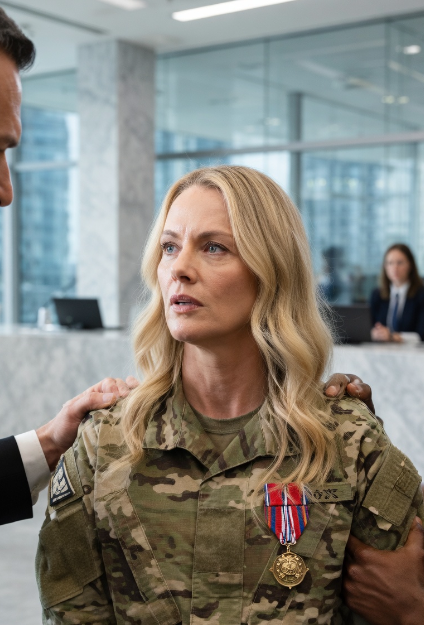
You Call That Medal a Cheap Toy? The Prosecutor Mocked Her—Then the Woman on Trial Saved a Life and Exposed the Truth
The air in the Fairfax County courtroom was thick, not just with the humidity of a Virginia summer, but with the suffocating weight of public judgment. Reporters lined the back benches like vultures on a wire, their pens poised to tear into the remains of a reputation. The case was a “slam dunk” for the prosecution, a perfect narrative of vanity and deceit.
At the center of the storm sat Claire Markham.
She was thirty-four, with hair pulled back in a severe, practical bun and a suit that looked two sizes too large for her lean, corded frame. She didn’t look like a fraud. She didn’t look like a hero, either. She looked like a woman who had forgotten how to exist in a room without a mission.
Nolan Pierce, the Assistant District Attorney, paced the floor with the predatory grace of a man who knew the cameras were watching. He held the evidence bag aloft, the Distinguished Service Cross catching the overhead fluorescent light.
“You call this medal a family legacy?” Pierce’s voice dripped with a practiced, theatrical disdain. “I call it a cheap toy. A twenty-dollar piece of polished tin ordered from a surplus website to fill a void in a mediocre life.”
He turned to the jury, his smile thin and sharp. “Stolen valor isn’t just a lie, ladies and gentlemen. It is a theft. It is stealing the blood, the sweat, and the very souls of the men and women who actually bled for these ribbons. Miss Markham here didn’t just wear the uniform; she wore the history of Delta Force. She claimed to be a Captain. She claimed to lead men in shadows where most of us fear to tread. And yet, there is no record. No file. No Captain Claire Markham exists in the Department of Defense archives. There is only a girl from Ohio who vanished for ten years and came back with a chest full of hardware she bought on the internet.”
Claire said nothing. Her lawyer, a public defender named Marcus Thorne who looked like he’d rather be anywhere else, shifted uncomfortably. He had tried to get her to take a plea deal. She had refused.
“I didn’t buy it,” Claire said, her voice low but carrying a strange, resonant frequency that silenced the room.
Pierce laughed, a short, barking sound. “Then where did it come from, Claire? Was it a gift? Did a real soldier leave it in a bar? Or did you just find it in a cereal box?”
“It was pinned to my chest,” she replied steadily, “by a man whose name you aren’t cleared to hear, in a room that doesn’t officially exist.”
The gallery erupted in hushed snickers. Pierce rolled his eyes. “The ‘classified’ defense. Classic. Tell me, Captain, does your imaginary unit also use invisible jets?”
The Breaking Point
The trial dragged into its second hour. Pierce was methodical. He brought up digital footprints—or the lack thereof. He showed tax returns that were blank for years. He brought in a retired Colonel who testified that he had never heard of a female Captain in Delta Force during the years in question.
“The Special Operations Command is a small world,” the Colonel testified, looking at Claire with genuine anger. “We know our own. This woman is an insult to the Creed.”
Claire took the stand in the afternoon. She didn’t offer excuses. She didn’t cry. She simply repeated the same facts: she had served, the records were sealed under Operation Night-Fall, and the medal was earned in the Hindu Kush.
“You’re a delusional narcissist, Miss Markham,” Pierce spat during cross-examination. He leaned in close, his face inches from hers. “You crave the respect you never earned. You’re a ghost story told by a liar. This medal—” he pointed at the DSC on the table “—is a toy. And today, the game ends.”
Then, the world shifted.
A heavy thud echoed from the back of the room. At first, people thought a reporter had dropped a camera. But then came the gasping—a wet, desperate sound that cut through the legal bickering.
Judge Halloway’s bailiff, a man in his sixties named Arthur, had collapsed. He was clutching his throat, his face turning a terrifying shade of plum-purple. His legs kicked spasmodically against the floor.
“He’s choking!” someone screamed.
The courtroom dissolved into chaos. Pierce froze, his mouth still open from his last insult. The Judge was shouting for a medic, but the nearest paramedics were ten minutes away through Fairfax traffic. A few people rushed forward, but they fumbled, panicked by the sheer violence of Arthur’s struggle. He wasn’t just choking; he was suffering a massive anaphylactic reaction combined with a collapsed airway. His throat was closing tight.
“Get back!” Claire’s voice didn’t just carry this time; it commanded.
She didn’t walk; she blurred. She was over the defense table and across the floor before Marcus Thorne could even blink. She shoved a panicked intern aside and dropped to her knees beside the dying bailiff.
“Arthur, look at me,” she said. It wasn’t a request. Her eyes locked onto his, providing a tether of calm in his sea of agony.
She felt his neck. The trachea was shifted. His pulse was thready, leaping like a dying bird. “He’s got a tension pneumothorax and his airway is completely obstructed by laryngeal edema,” she snapped.
“Wait, you can’t touch him!” Pierce yelled, finally finding his voice. “You’re not a doctor!”
Claire didn’t look at him. “He has sixty seconds before his heart stops. Someone give me a pen. A metal one. Now!”
A court reporter handed over a high-end fountain pen. Claire unscrewed it with a sharp twist, discarding the ink reservoir. She looked at the Judge. “I need a sharp blade and high-proof alcohol. Now!”
The Judge, frozen in shock, pointed to his desk where a small letter opener sat. Claire grabbed it.
The room went silent, save for the horrific whistling sound of Arthur’s failing lungs. With the precision of a diamond cutter, Claire positioned the letter opener over Arthur’s cricothyroid membrane.
“This is going to hurt, Artie. Stay with me.”
In one swift, horrifyingly confident motion, she made the incision. Blood spurted, staining her oversized suit jacket. The gallery gasped; some turned away. She didn’t flinch. She inserted the barrel of the fountain pen into the hole.
A hiss of air escaped—a sound of life returning. Arthur’s chest began to rise and fall, shallowly but rhythmically.
But she wasn’t done. She took a second pen, broke the casing, and felt for the space between his ribs. “Lungs are collapsing from the pressure,” she muttered. She drove the second tube into the pleural space. A sickening pop echoed, followed by a rush of air.
Arthur’s color began to fade from purple back to a pale, sweating grey. He took a ragged, deep breath through the fountain pen in his throat.
Claire stayed there, her hands covered in blood, holding the tubes in place. Her eyes never left the bailiff’s. She was whispering to him—low, rhythmic strings of numbers and phrases, a tactical grounding technique used to keep soldiers from going into shock.
The paramedics burst in five minutes later. They skidded to a halt, seeing the makeshift surgery.
“Who did the cric?” the lead medic asked, reaching for his kit.
“I did,” Claire said. She didn’t move until they had stabilized him with professional equipment. When she finally stood up, she was drenched in blood. She looked at her hands, then at the stunned courtroom.
She walked back to the defense table, picked up a tissue, and began to wipe her fingers.
The Arrival
The trial didn’t resume immediately. The Judge called a recess, but no one left. The atmosphere had shifted from a circus to a cathedral. Nolan Pierce sat at his table, looking at the blood on the floor, then at Claire. He looked small.
“That doesn’t prove she’s a Captain,” Pierce whispered, though it sounded like he was trying to convince himself. “It just proves she knows first aid.”
“That wasn’t first aid, Nolan,” the retired Colonel from the witness stand said. He was standing near the railing, his face pale. “That was a battlefield tracheotomy and a needle decompression. I’ve seen surgeons in the Green Zone shake while doing that. She didn’t even have a pulse-check.”
Just as the Judge was about to reconvene, the heavy double doors at the back of the courtroom swung open.
This time, it wasn’t the press.
Six men walked in. They weren’t in uniform. They wore civilian clothes—tactical pants, flannel shirts, boots. They all had the same look: the “thousand-yard stare” tucked behind expensive sunglasses, and a certain way of moving that suggested the floor belonged to them.
In the lead was a man with silver hair and a face that looked like it had been carved out of a mountainside. He walked straight to the front, ignoring the bailiff’s replacement.
“Who are you?” Judge Halloway asked, his voice echoing in the silent room.
The man didn’t answer the Judge. He looked at Claire. He took in the blood on her suit, the calm in her eyes, and the “cheap toy” sitting on the evidence table.
“The Phoenix decided to rise a little early, I see,” the man said.
Claire stood up. For the first time in the trial, she smiled. It wasn’t a happy smile; it was the smile of a soldier seeing a friendly flag. “Sir.”
The man turned to the Judge and placed a leather folder on the bench. “My name is General Silas Vance, Commander of USSOCOM. I am here to discuss the status of Captain Claire Markham.”
Nolan Pierce stood up, his voice cracking. “General, we checked the records. There is no Captain Markham. This woman is a fraud.”
General Vance turned his gaze toward Pierce. It was like a spotlight hitting a moth. “You checked the NIPR and SIPR nets, Counselor. You checked the systems designed for the public and the general military. You didn’t check the Onyx Tier.”
He turned back to the room. “Captain Markham doesn’t exist in your records because, for the last eight years, she has been the lead intelligence and medical officer for a Tier 1 unit operating under Title 50 authority. She hasn’t been in Ohio. She’s been in places that don’t have names.”
Vance picked up the Distinguished Service Cross from the evidence bag. He held it with a reverence that made Pierce’s earlier handling look like a sacrilege.
“This medal,” Vance said, his voice booming, “was awarded in a subterranean bunker beneath the Iranian border. Captain Markham stayed behind to stabilize three wounded operators while the extraction point was being overrun by a battalion-sized element. She held a scalpel in one hand and a carbine in the other for six hours until we could get a Bird in. She didn’t buy this for twenty dollars, Counselor.”
The General looked at Pierce, his eyes narrowing. “You called it a cheap toy. This ‘toy’ represents the lives of the three men standing in the back of this room today. They are alive because of her. Arthur is alive because of her.”
The silence that followed was absolute.
The Truth Exposed
The General wasn’t finished. He opened the folder. “We became aware of these proceedings forty-eight hours ago. It took that long to declassify the specific dates of her service to satisfy this court’s curiosity without compromising ongoing operations.”
He looked at the prosecutor. “I also had my staff look into why this case was brought so aggressively. It seems, Mr. Pierce, that you were very eager for a high-profile win before the upcoming election for District Attorney. You were so eager that you ignored the ‘Non-Disclosure’ flags on her social security number, which should have triggered a call to a specific number at the Pentagon. You bypassed protocol to humiliate a hero for a headline.”
Pierce was white-faced. “I… I was doing my job. The evidence looked—”
“The evidence looked exactly how we wanted it to look for anyone who wasn’t supposed to see her,” Vance interrupted. “But you aren’t just anyone. You’re an officer of the court. And you just attempted to imprison a soldier for the crime of keeping her mouth shut about her service to this country.”
The Judge didn’t even wait for a motion. He looked at Claire, his expression one of profound apology.
“Case dismissed with prejudice,” Halloway announced. He looked at Pierce. “Mr. Pierce, stay behind. We are going to have a very long conversation about prosecutorial misconduct and the ethics of your office.”
The Aftermath
As the courtroom cleared, the reporters scrambled out, their “stolen valor” stories being deleted in favor of “Secret Hero Saves Life in Court.”
Claire remained at the table. The adrenaline was fading, leaving her exhausted. The five men from the back of the room approached her. They didn’t say much. One of them, a man with a jagged scar across his jaw, simply put a hand on her shoulder.
“Good to see you, Doc,” he whispered. “Nice cric. A bit messy, but effective.”
“He was a bleeder,” Claire replied, her voice finally shaking just a little.
General Vance handed her the Distinguished Service Cross. “I’m sorry we couldn’t get the paperwork through faster, Claire. The bureaucracy is slower than a sniper’s crawl.”
“It’s okay, Sir,” she said, taking the medal. She looked at it—really looked at it. “I wasn’t going to tell them. I would have gone to jail before I broke my NDA.”
“I know,” Vance said. “That’s why you’re the Phoenix.”
As Claire walked out of the courthouse, she was no longer the “fraud” or the “imposter.” The sun hit the bloodstains on her suit, turning them a deep, dark crimson. She didn’t look at the cameras. She didn’t give an interview.
Across the street, she saw the ambulance doors closing. Arthur was being loaded inside. He was awake. Through the window, he saw her. He couldn’t speak, but he touched his hand to his brow in a shaky, weak salute.
Claire returned the salute—a perfect, crisp movement that had been practiced in the shadows of the world, now performed in the light of the truth.
Nolan Pierce watched from the window of the courthouse as she disappeared into the crowd. He looked down at the empty evidence bag on his table. He had called it a cheap toy. He had mocked the very thing that made him safe enough to stand in a courtroom and lie.
He realized then that the woman he had tried to destroy wasn’t just a soldier. She was a reminder that some things are too heavy for a man like him to ever carry—the weight of gold, the price of blood, and the silence of a true hero.
Claire Markham walked home. She had no job, her reputation was a chaotic mess of viral videos, and she needed a new suit. But as she felt the cool weight of the medal in her pocket, she knew she was no longer a ghost.
She was home. And for the first time in ten years, she didn’t have to hide.
The truth hadn’t just set her free; it had saved a life. And in the end, that was the only medal that ever mattered.
Epilogue: Six Months Later
The Fairfax County Courthouse had a new bailiff, but Arthur was back, too—working part-time in the records office. A small plaque had been placed near the spot where he fell, not mentioning secret units or classified missions, but simply thanking “An Anonymous Friend” for life-saving service.
Nolan Pierce’s career ended not with a bang, but with a quiet resignation following a bar association investigation.
And Claire? Claire didn’t go back to the shadows. She became a lead instructor for a tactical medicine program, teaching others how to find a heartbeat in the middle of a war zone. She still kept the medal in a drawer. Sometimes, she’d take it out when the night felt too long or the world felt too loud.
She would run her thumb over the “cheap toy” and remember the whistling sound of a man’s breath returning. She realized that the prosecutor was right about one thing: the medal itself was just metal and ribbon. Its value didn’t come from the surplus store or the Pentagon.
It came from the moment she decided that someone else’s life was worth more than her own secret. And that was a truth no courtroom could ever take away.