STREAMING NOW ON NETFLIX: KERI RUSSELL AND RUFUS SEWELL IN A MASTERCLASS OF POWER DYNAMICS!
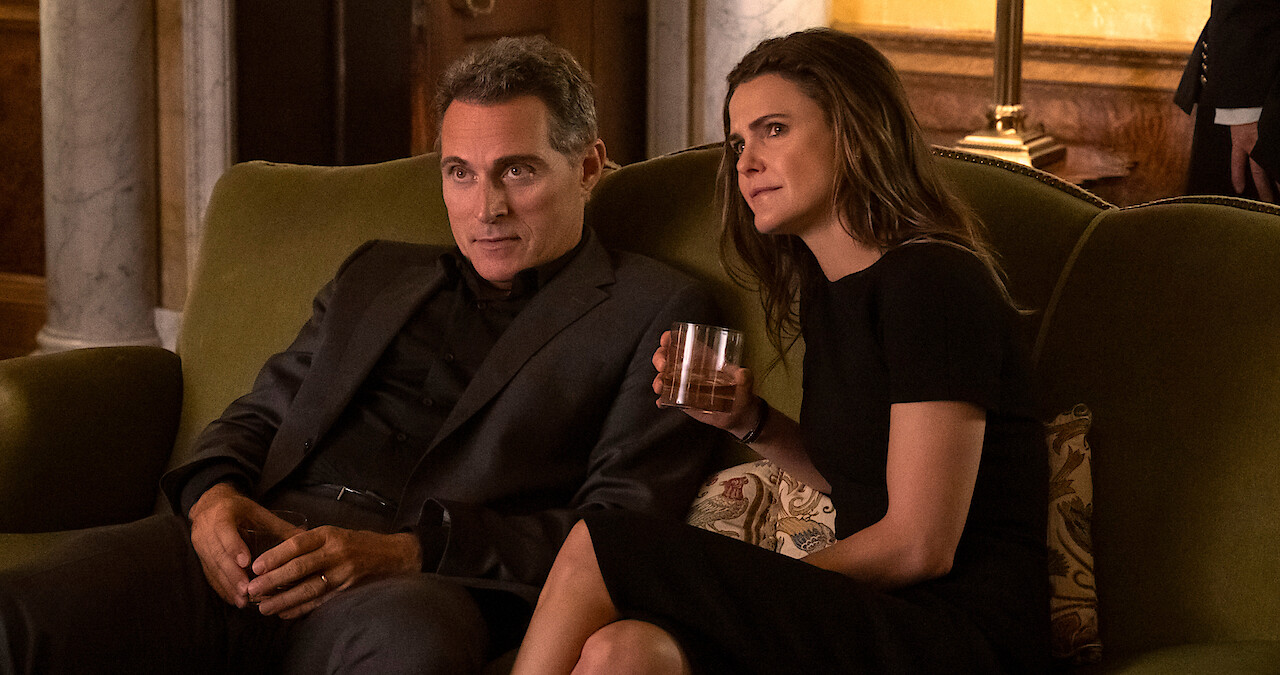
Partners in life, rivals in political ambition. On Netflix, Keri Russell and Rufus Sewell star as Kate and Hal, a high-profile power couple whose deteriorating marriage is as chaotic as the international conflicts they try to solve. As they sit side by side in silence, the hidden motive behind Hal’s advice tonight proves far more dangerous than any foreign threat.
In the high-stakes world of modern diplomacy, few pairings on screen have captured the toxic glamour of a power marriage quite like Kate and Hal Wyler. Netflix’s The Diplomat has turned the private warfare of one American couple into appointment viewing, and the latest chapters deliver a clinical dissection of ambition, resentment, and the razor-thin line between love and leverage. Keri Russell’s Kate is the no-nonsense career diplomat who thrives in crisis zones yet recoils from the polished theater of ambassadorial life. Rufus Sewell’s Hal is the magnetic political operator whose charm can open doors—or detonate them. Together they form a tandem couple whose professional brilliance is matched only by the quiet erosion of their personal bond.
The premise is deceptively simple. Kate is abruptly posted as U.S. Ambassador to the United Kingdom at a moment of acute international peril. What begins as a crisis-management assignment quickly becomes a pressure cooker in which every public appearance, every private conversation, and every whispered piece of advice carries the weight of both national security and marital survival. Hal, once the more prominent of the two, finds himself in the unfamiliar position of supporting player. The role does not sit easily. He is too clever, too restless, and too accustomed to being the center of gravity to remain quietly on the sidelines. The result is a relationship that functions like a perpetual negotiation: affection mixed with calculation, support laced with sabotage, intimacy that can turn into interrogation at any moment.
What elevates the series beyond standard political thriller fare is the way it treats the marriage itself as the primary theater of conflict. International crises—carrier attacks, shifting alliances, presidential succession dramas—serve as the backdrop against which Kate and Hal’s private power struggle unfolds. Their arguments are rarely about the dishes or who forgot an anniversary. They are about strategy, timing, and whose vision of the greater good should prevail. Hal’s counsel is almost never purely altruistic. When he leans in with that practiced, half-smile and offers advice, viewers have learned to watch Kate’s face for the flicker of suspicion. Is he helping her, or is he positioning himself? Is the suggestion designed to strengthen her hand, or to create an opening he can later exploit?
The show’s most compelling sequences are often the quietest. Russell and Sewell excel at the charged silence that follows a carefully chosen remark. A single glance across a formal dinner table can convey years of accumulated grievances. A shared car ride becomes a high-wire act of mutual assessment. In one recurring motif, the couple sits side by side—on a plane, in a secure room, in the back of an official vehicle—saying almost nothing while the air between them crackles with unfinished business. It is in these moments that the series reveals its true subject: not the fate of nations, but the cost of two people who cannot stop measuring themselves against each other.
Critics and audiences have noted how skillfully the writing maps professional dynamics onto marital ones. In the foreign service, tandem couples are common, and the practical and emotional complications are well documented. One partner’s posting can sideline the other. Ambition that once felt shared begins to feel competitive. The public narrative of a united front collides with private calculations about whose career should take precedence. The Diplomat amplifies these tensions to operatic levels without losing the granular, almost documentary sense of how such relationships actually function. Hal’s interventions are frequently brilliant and frequently reckless. Kate’s responses mix genuine respect for his political instincts with a growing refusal to be managed. Their shared history becomes both asset and liability. They know each other’s tells too well to be easily deceived, yet they remain capable of surprising—and wounding—one another.
The performances anchor the material. Russell brings a taut, intellectual intensity to Kate: a woman who can read a room in seconds and who is increasingly unwilling to sacrifice her own moral compass for the sake of the partnership. Sewell’s Hal is a study in seductive chaos—charming, impulsive, capable of genuine loyalty and equally capable of treating people as chess pieces. Their chemistry is not the soft, romantic variety. It is the dangerous kind that comes from two people who still find each other compelling even as they prepare to draw blood. When they argue, the dialogue has the rapid, overlapping quality of people who have had the same fight in slightly different forms for years. When they fall briefly back into physical intimacy, the scenes carry the uneasy charge of unfinished business rather than pure reconciliation.
As the series has progressed, the balance of power between the two has shifted multiple times, each recalibration raising the stakes. What once looked like a temporary separation of roles has hardened into something more structural. One partner’s rise can feel like the other’s demotion. Advice that once registered as strategic support begins to sound like self-preservation. The international crises they navigate—false-flag operations, succession battles, the constant threat of escalation—mirror the private ones. Alliances form and fracture. Motives remain opaque. Trust becomes a scarce and constantly renegotiated resource.
The genius of the show lies in its refusal to declare a clear hero or villain inside the marriage. Both characters are capable of nobility and of calculation. Both believe, at least some of the time, that they are acting for the greater good. Both are also capable of using that belief as cover for more personal agendas. Viewers are left to decide, scene by scene, whether Hal’s latest suggestion is an act of partnership or an act of positioning. The same uncertainty applies to Kate’s responses. Silence itself becomes a form of power. A withheld reaction, a carefully neutral expression, a decision not to confront—these become as consequential as any formal diplomatic démarche.
In an era of glossy political dramas that often prioritize plot twists over character, The Diplomat distinguishes itself by treating the marriage as the main event. The global stakes provide spectacle and urgency, but the lasting tension lives in the space between two people who know each other too well to pretend. When Kate and Hal sit side by side in silence, the question is never merely what Hal is about to say. It is what he hopes the advice will achieve—for her, for him, and for the carefully maintained fiction that they are still on the same side.
Streaming now on Netflix, the series continues to deliver a masterclass in the private politics of public lives. Partners in life. Rivals in ambition. And in the charged quiet between them, motives that may prove more consequential than any crisis on the world stage.