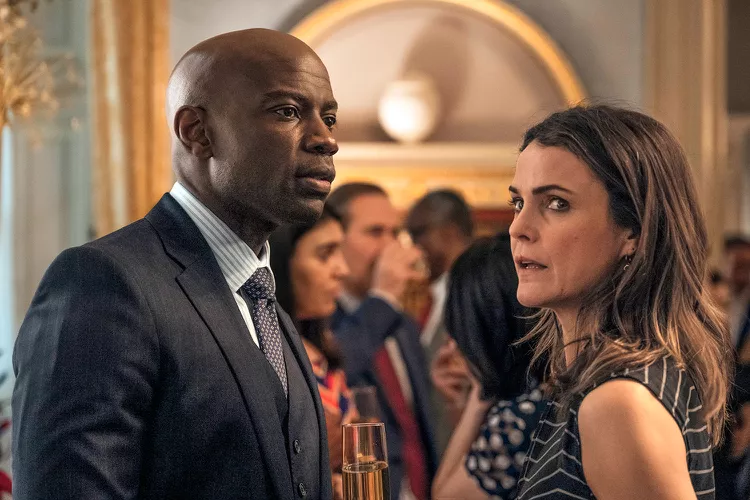
THE HIGH-STAKES POLITICAL THRILLER ON NETFLIX THAT PUTS DAVID GYASI AND KERI RUSSELL IN AN INTENSE GAME OF POWER
Allies on the surface, strategic rivals behind closed doors. On Netflix, David Gyasi and Keri Russell deliver a sharp, magnetic performance as Austin Dennison and Kate Wyler, navigating a dangerous political minefield. The unexpected warning Dennison gives Kate right as she turns to leave proves…
In the polished corridors of power, where every handshake can conceal a calculation and every shared glance risks becoming a liability, few pairings crackle with the controlled electricity of Austin Dennison and Kate Wyler. Netflix’s The Diplomat has turned their uneasy alliance into one of the most watchable dynamics on television—a relationship that feels less like simple diplomacy and more like a high-wire act performed over open flame.
Kate Wyler, played with fierce, slightly disheveled brilliance by Keri Russell, arrives in London as the newly installed U.S. ambassador at the worst possible moment. A British aircraft carrier has been attacked. Bodies are still being counted. The world is one misread intelligence report away from catastrophic escalation. She is a crisis specialist yanked from the relative clarity of war zones into the far murkier theater of alliance management, where the enemy is rarely as obvious as the person sitting across the table smiling.
Opposite her stands Austin Dennison, the British Foreign Secretary brought to life by David Gyasi with quiet steel and unexpected vulnerability. Dennison is polished where Kate is blunt, measured where she is impulsive, and burdened by the delicate task of serving a prime minister whose instincts often run hotter than the evidence allows. On the surface they are natural partners: two senior officials from the closest of allies, united by the need to prevent a regional crisis from becoming a global one. Behind closed doors, the picture grows far more complicated.
What makes their scenes so compelling is the constant negotiation of trust. Dennison and Kate recognize each other as equals in a profession that rarely rewards honesty. They trade information in half-sentences and loaded silences. They protect each other when it serves the larger interest and withhold when survival demands it. The chemistry is not the soft-focus romance of lesser dramas; it is the harder, more dangerous attraction of two people who understand exactly how much damage the other could do if the alliance ever fractured.
Russell plays Kate as a woman who has spent years operating in environments where charm is a secondary skill at best. She arrives in London already exhausted by the performance of power and allergic to the pageantry that comes with the ambassador’s residence. Gyasi’s Dennison, by contrast, has mastered the performance. His suits fit. His timing is exquisite. Yet beneath the composure runs a current of private calculation that only Kate seems fully equipped to read. When they are alone, the masks slip just enough to reveal two professionals who are both more and less certain than they pretend.
The series thrives on these moments of near-revelation. A spilled drink becomes an intimate accident. A private conversation in a country house carries the weight of mutual recognition. A late-night exchange over whisky turns into something closer to confession. Each encounter advances the larger geopolitical plot while tightening the personal stakes. Viewers are left wondering not only who ordered the original attack, but whether Kate and Dennison will ultimately choose institutional loyalty or each other when the two finally collide.
That tension reaches its sharpest point in the moments the promotional language teases so effectively. There is a particular exchange—one that arrives just as Kate is preparing to leave—in which Dennison offers a warning that lands with the force of a quiet detonation. It is not shouted. It is not dramatic in the conventional sense. It is delivered with the careful precision of a man who understands that certain truths, once spoken, cannot be unspoken. The words themselves are restrained. The implication is not. In that brief interval, the carefully maintained balance between ally and something more precarious shifts, and the audience is left holding its breath.
The brilliance of The Diplomat lies in how thoroughly it refuses easy categorization. It is a political thriller that understands the genuine stakes of international crisis. It is also a character study of two people whose professional competence is inseparable from their personal isolation. Kate’s marriage to Hal Wyler (Rufus Sewell) provides a constant counterpoint—messy, intimate, and full of its own power struggles. Dennison’s private life remains more carefully guarded, which only heightens the sense that his connection with Kate occupies a rare unprotected space.
Creator Debora Cahn, drawing on her experience with The West Wing and Homeland, writes dialogue that rewards close attention. The conversations between Dennison and Kate are layered with subtext. What is said matters. What is carefully not said often matters more. Gyasi and Russell play these scenes with a restraint that makes every small breach of protocol feel significant. A prolonged look. A half-step closer than protocol allows. A warning delivered at the precise moment when walking away would have been safer.
The result is a relationship that feels genuinely high-stakes. In a lesser series, the attraction between the American ambassador and the British Foreign Secretary would be reduced to romantic subplot. Here it functions as another front in the larger conflict. Every shared confidence risks exposure. Every moment of genuine connection creates a vulnerability that hostile actors—or ambitious colleagues—could exploit. The personal and the political are not parallel tracks. They are the same track, and the train is moving fast.
As the series has continued across subsequent seasons, the fundamental tension between Kate and Dennison has only grown richer. Alliances shift. Governments change. The original crisis expands into something larger and more treacherous. Through it all, the question of what Dennison and Kate truly owe each other remains unresolved. Are they partners of convenience bound by the necessities of the moment? Or have they become something rarer and more dangerous—two people who see each other clearly in a profession built on strategic ambiguity?
That unanswered question is the engine of the drama. It is also the reason the pairing of Gyasi and Russell continues to dominate conversation around the show. Their scenes together carry a specific charge: the sense that both characters are perpetually calculating the cost of honesty while privately craving it. When Dennison issues that unexpected warning just as Kate turns to leave, the moment crystallizes everything the series does best. Power is never clean. Trust is never complete. And the most important conversations often happen in the seconds before someone walks out the door.
The Diplomat understands that the real intrigue of high-level diplomacy is rarely found in the formal statements or the staged press conferences. It lives in the private rooms, the interrupted conversations, and the warnings that arrive too late or just in time. David Gyasi and Keri Russell make that world feel urgently, uncomfortably real. Allies on the surface. Strategic rivals when it counts. And somewhere in the charged space between those two realities, a relationship that keeps viewers leaning forward, waiting for the next carefully chosen word that might change everything.