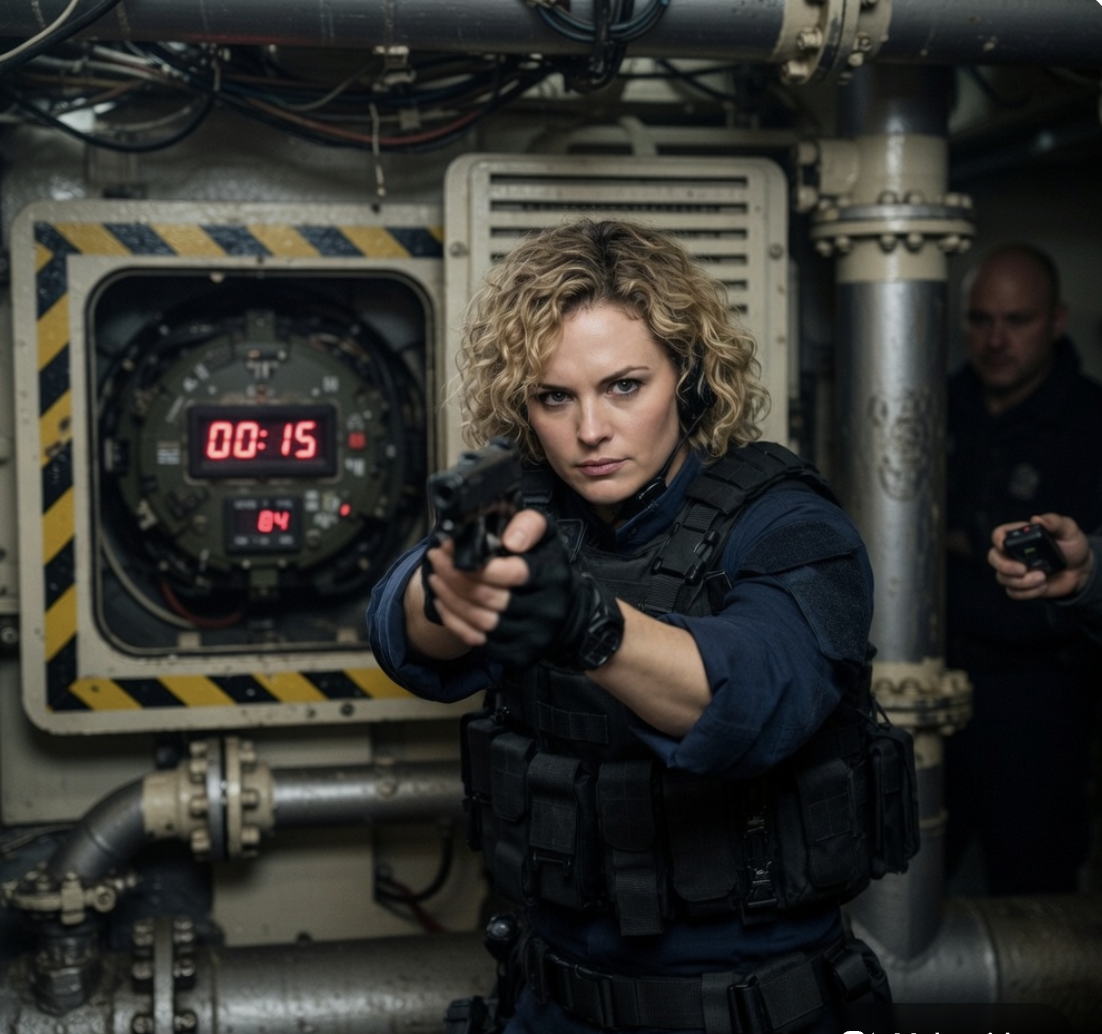
Navy Ship Bomb Expert Faces Impossible Choice — Defuse It or Hunt the Man With the Trigger
Part 1
By the time the bomb found me, my coffee had already gone cold twice.
That was life on a destroyer. You learned to like things interrupted. Sleep, showers, sentences, homesickness, all of it. The USS Michael Murphy cut through the Arabian Sea with the steady, low vibration of a machine that never truly rested. Even in the mess deck, with the smell of powdered eggs, burnt bacon grease, and industrial coffee hanging in the air, you could feel the ship working through your boots.
I was Petty Officer First Class Sarah Chen, explosive ordnance disposal technician, six years in EOD and eleven in the Navy. On paper, I was the calm one people called when something ugly started ticking. In real life, I was thirty-two, permanently underslept, and trying not to think too hard about my four-year-old daughter back in San Diego with my parents.
That morning I had listened to Emma’s newest voice message three times.
“Mommy, Grandpa says octopus has three hearts. Is that true? Also I want the shark pajamas when you come home. Not the blue shark. The happy shark.”
I had smiled into my coffee like an idiot while two fire controlmen argued nearby over baseball and one of the cooks slammed a tray rack hard enough to rattle the silverware bin. Emma always made the ship feel farther away and more bearable at the same time.
Then Chief Rodriguez found me.
He came through the mess deck at a half-run, big shoulders cutting around sailors and chairs, coffee sloshing out of my cup when he grabbed the back of my chair.
“Chen. Move.”
He didn’t have to say more than that. You learn the difference between normal urgency and the kind that smells like metal and bad luck before the actual smell reaches you.
I was already up, shoving the phone with Emma’s message back into my pocket. “What did they find?”
“Engineering called it in. Hidden behind a ventilation panel in auxiliary engine room two.”
That word did something to my spine. Hidden.
Not dropped. Not misplaced. Not suspicious. Hidden.
I followed him at a run, tray chatter and galley noise fading behind us as we hit the passageway. The ship’s fluorescent lights gave everybody the same sick pale color. We went down two ladders, then another, deeper into the part of the destroyer that always smelled like hot oil, paint, old steel, and the faint sourness of trapped heat. A destroyer’s engineering spaces feel like the inside of a throat—tight, loud, essential, and never meant for comfort.
A machinist mate named Delaney met us by the auxiliary engine room hatch, sweaty and gray-faced, one glove tucked into his waistband.
“Behind the intake panel,” he said. “I saw wire where there shouldn’t be wire.”
Good man. Smart enough not to touch.
“Who else saw it?”
“Me and Chief Wilkes. We backed out and secured the space.”
I nodded and pulled on gloves while Rodriguez gave the word to clear the compartment. My EOD kit felt heavier than usual, the straps biting into my shoulders as I crouched near the open panel.
At first glance, it looked almost clean. That was the worst kind.
Thirty pounds, maybe a little under, packed in military-green blocks inside a reinforced frame. C4, real stuff, not some garage-built nonsense. Detonator assembly was nested low and shielded. A digital timer glowed red through a steel cage mounted just far enough back that I couldn’t get cutters on it without first dealing with the cage. There were anti-handling switches tucked under the support brackets, and a secondary line wired through the vent housing in case somebody tried to yank the unit free.
I leaned closer inside the blast shield and felt the blood drain from my face.
The timer read 01:29.
“Jesus,” Rodriguez breathed behind me.
I should’ve corrected him. I didn’t.
I keyed my headset. “Chen to bridge.”
Commander Elise Hastings came on immediately, voice clipped so tight I could almost hear her jaw. “Report.”
I swallowed once and forced my voice flat. Flat is good. Flat means people think you still own the room.
“Device is military-grade C4. Rough estimate thirty pounds. Sophisticated build, dual initiation setup, anti-tamper protections, visible timer unreachable behind reinforced cage.”
“How long to disarm?”
I stared at the steel cage, the orientation of the switches, the way the detonator line vanished under the block arrangement. My brain was already solving paths and rejecting them.
“Not enough time, ma’am.”
A beat.
“Define not enough.”
“I’d need ten minutes to make a safe approach if the timer wasn’t live. Maybe more. We have less than ninety seconds.”
Silence on the line. Not empty silence. Decision-making silence. Around me the engine room seemed to breathe hotter. Somewhere behind the bulkheads, pumps kept cycling like the ship didn’t know it was one bad minute from becoming a coffin.
I shifted slightly and saw it.
A small receiver module fixed under the timer housing, tucked almost out of sight. Not elegant, but deliberate. RF-capable, hardwired into the initiation system.
“Hold,” I said.
I leaned in again, careful, careful, and my stomach went colder.
“Bridge, device includes radio receiver. I say again, radio receiver is present.”
Hastings was silent for maybe half a second. “Meaning?”
“Meaning somebody can trigger this remotely before the timer runs out.”
Rodriguez muttered something under his breath that I let pass because he wasn’t wrong.
I looked at the timer. 01:11.
The cage made sense now. The anti-handling switches made sense. The visible countdown wasn’t the real trap. It was pressure. Panic. Something to keep me busy at the device while the person with the transmitter stayed one step ahead.
“Can you jam the signal?” Hastings asked.
“Not from here. Not shipwide in under a minute. And if I start disrupting blind, anti-tamper could fire the detonator chain immediately.”
The timer flipped to 01:03.
I could hear my own pulse inside the helmet. Sweat slid down my back under the suit lining.
Then the only ugly option I had left stood up in my mind and refused to sit back down.
“Ma’am,” I said, “I cannot safely disarm this before detonation. But I may not need to.”
Rodriguez turned his head toward me.
Hastings’ voice sharpened. “Explain.”
“Whoever built this understands ship systems, restricted spaces, and response timing. If they wired a remote trigger, they’re aboard and close enough to use it. If I go after the bomb, I lose. If I find the person with the transmitter before the timer hits zero, I can stop the detonation.”
For one second nobody answered. All I could hear was the timer’s soft electric click changing numbers and the dull roar of ventilation through the compartment.
The red display rolled down to 00:54.
“You’re certain?” Hastings asked.
“No, ma’am,” I said. “I’m seventy percent certain. But it’s the only play we have.”
Another second.
Then Hastings made the call that saved the ship.
“Do it. Master-at-arms, get on Chen’s channel. Security alert. Lock down restricted movement. Quietly. We are not stampeding my crew into steel walls with a live bomb below them.”
Rodriguez was already moving. “On it.”
I stood, my knees suddenly aware of themselves again.
“Chen,” Hastings said, “where do you start?”
That was the worst question because it was the right one.
The USS Michael Murphy was five hundred feet of steel, wires, pipes, stacked compartments, hidden corners, and nearly four hundred souls. The bomber could be anywhere from the bridge to the laundry. He could be in coveralls, behind a console, carrying a clipboard, doing the exact face every sailor does when they’re trying not to be noticed.
I looked once more at the red digits counting down behind the cage.
00:47.
Then I turned and ran for the hatch.
If I chose wrong, I wasn’t just dying.
I was taking the whole ship with me.
Part 2
A destroyer sounds different when everybody is trying not to panic.
That was the first thing I noticed once I left engineering. The ship hadn’t gone to full general quarters. Hastings was too smart for that. A full alarm would’ve turned every passageway into a metal stampede, and if the bomber wanted chaos, we’d be handing him dessert. Instead, we got the controlled version—quiet orders on command circuits, security teams moving faster than usual, doors dogging shut one at a time, watchstanders suddenly standing straighter because they could hear tension in voices even when they couldn’t hear words.
My boots hammered the deck plates as I hit the ladderwell, EOD bag bouncing off my spine. The air up one level was cooler, touched with cleaning solution and old coffee instead of machine heat. My breath already tasted like copper.
“Rodriguez,” I said into the headset, “I need access logs for auxiliary engine room two. Past week.”
“Pulling now.”
I took the ladder two rungs at a time. A boatswain’s mate flattened himself against the bulkhead to let me pass, eyes flicking to my bomb suit components and then away. Good. Let rumors start later.
“What am I looking for?” Rodriguez asked.
“Authorized access, unusual hours, duplicate entries, anybody with reason to know that compartment and enough technical competence to hide a dual-init device.”
A pause full of keyboard noise. Then: “That gives you half the damn ship.”
He wasn’t wrong.
The auxiliary engine room wasn’t some tourist stop. It was restricted, yes, but lots of people touched it over time—engineering crews, inspectors, maintenance techs, damage control teams. On a destroyer, access and necessity overlap constantly. One person signs off, another escorts, a third borrows a tool, a fourth gets waved through because everyone knows everyone’s face.
I reached the next passageway and nearly clipped a petty officer carrying a spool of cable.
“Sorry, ma’am.”
“No, you’re not,” I muttered, already past him.
My mind ran faster than my legs. The bomb’s placement had been professional. Hidden behind a ventilation panel, close enough to the hull and machinery lines that thirty pounds of C4 would do catastrophic work. Whoever set it knew not just where to place explosive, but where it would hurt the ship most.
That narrowed things some.
Not a random sailor. Not somebody who got lucky with a YouTube video and a death wish. This was military knowledge. Training. Access.
“Chen,” Rodriguez said, “forty-three people had authorized access to that compartment in the last seven days.”
I hit the main passage and turned hard enough to smack my shoulder on a watertight frame. Pain flared, then got left behind.
“I don’t have time for forty-three. I need flags. Discipline. money problems. psych notes. anyone recently denied transfer, promotion, or clearance.”
“Some of that’s restricted.”
I stopped dead in the passage, chest heaving.
“Chief, there’s a bomb in my engine room. Override your inner paperwork fairy and give me names.”
He didn’t answer for two long seconds.
Then he said, lower now, “Three.”
I started moving again.
“Petty Officer Second Class Marcus Webb. Machinist mate. Gambling debt rumors, confirmed counseling on financial irresponsibility, denied shore leave extension in Bahrain.”
Webb. Good with machinery, knew engineering spaces cold. Also too obvious, maybe. A man drowning in debt is either the right suspect or the one everyone wants to hand you because he makes the story easy.
“Next.”
“Petty Officer Third Class Amy Sutton. Supply. Failed a random urinalysis last month. Administrative action pending.”
That tugged for a second. Supply touched everything. If components had moved through the ship without questions, supply was one route. But the bomb’s craftsmanship felt above Sutton’s lane. Not impossible. Just off.
“Third.”
“Ensign Bradley Michaels. Intelligence specialist. Reprimanded two weeks ago for unauthorized access to classified material. Temporary waiver for follow-on billet under review.”
I hit the next ladderwell and froze with one hand on the rail.
Michaels.
He had electronics training. Not deep EOD, but enough communications and systems knowledge to wire a receiver and understand command net flow. He worked in information spaces, knew how people responded under pressure, knew where the ship’s eyes and ears lived.
Also, unlike Webb, he had a reason to be somewhere outside his normal world if he was careful about it. Intel types wandered. They got into places on the strength of clearances and paperwork. Half the crew assumed they belonged wherever they stood because nobody wanted to admit they didn’t understand what intel actually did.
“Where is Webb right now?” I asked.
“Engineering accounted for. Security team already eyes-on.”
Too easy.
“Sutton?”
“In supply office. Also watched.”
My grip tightened on the rail.
“Michaels?”
There was a pause long enough to feel personal.
Then Rodriguez said, “Combat Information Center. Standing watch.”
I changed direction without thinking.
The ladderwell to CIC was steeper, narrower, meaner on the knees. As I climbed, every piece of the picture sharpened until it hurt.
If I were running a remote trigger inside a destroyer, where would I put myself? Not near the bomb. Too risky. Not in open berthing. Too exposed. I’d put myself somewhere secure, somewhere I could hear command traffic, watch the crew react, and know exactly how close the device was to being discovered or disrupted.
CIC.
The ship’s nerve center. Dark, insulated, full of radar scopes and tactical displays and enough radio chatter to hide your own pulse. Also one of the few places where a man standing still with one hand in his pocket wouldn’t immediately look wrong.
“Rodriguez,” I said, taking the last ladder fast enough to feel it in my throat, “quietly lock external doors to CIC. No alarm inside yet.”
“Already on it.”
“How much time?”
A beat. “Thirty-eight seconds from your last call.”
Less now.
I blew past two operations specialists in the anteroom. The lighting changed there, brighter outside the secure door, dim red spill creeping from within. My lungs felt like sandpaper. Sweat had collected under my helmet padding and was now cooling fast against my skin.
As I shoved through the final door, the darkness inside hit me first.
CIC always feels like a cave designed by math. Black consoles, ghostly screens, green and amber radar sweeps, sailors lit from below like campfire stories told by machines. The air smells like electronics, stale coffee, and recycled cold.
Voices overlapped in controlled bursts. Track reports. Navigation notes. Communications traffic. A sonar tech turned halfway toward the hatch when I entered and then turned back, assuming, maybe, that whatever mess I was carrying belonged to somebody else.
I scanned left to right.
Watch officer. Two OSs at consoles. Communications station. Electronic warfare. Another junior officer near the plotting table.
Then I saw him.
Ensign Bradley Michaels stood just off the comms bank, posture too loose for the tension in the room, one hand resting near his pocket. He was looking toward a tactical display, but not really at it. His attention had that split-focus quality I’d seen before in people trying to seem normal while waiting for something to happen.
And then his eyes found mine.
It wasn’t fear I saw first.
It was recognition.
A tiny flicker. A calculation.
Then his hand moved toward his pocket.
Every sound in CIC seemed to sharpen at once—the fan hum behind the consoles, the click of a keyboard, somebody inhaling to ask a question that never got asked.
I knew before I even saw the black edge of the device.
I had found the right man.
The problem was, so had he.
Part 3
“Hands where I can see them,” I said.
I don’t remember deciding to draw my pistol. My hand was just suddenly there, on the grip, thumb finding familiar contours, every range day I had ever resented collapsing into muscle memory.
CIC reacted a half-second late, which is about how long it takes for a room full of trained people to understand they’ve stepped into somebody else’s emergency.
Michaels’ hand came out of his pocket holding a small black transmitter the size of a garage-door remote, except this one had a red button set square in the center. His thumb hovered over it. Not touching. Ready.
Nobody in that room needed me to explain what it was. Not after the look on my face.
“Back up,” Michaels said.
His voice cracked on the second word. Sweat shone on his forehead under the dim light. He was pale in that waxy way people go when the body knows it has crossed some line the mind can’t uncross.
Behind me, somebody hissed, “Gun,” and somebody else answered, “Don’t shoot.”
Smart.
A kill shot is neat in movies. In real life, nerves fire when bodies die. Hands clench. Fingers curl. A dead man can still press a button if you hit him wrong and late enough.
I eased the pistol free but kept it low.
“Michaels,” I said, because rank wasn’t going to help me now. “Talk to me.”
He laughed once. Thin, ugly. “You think this is a conversation?”
I took one step into the room and felt every eye track me.
“Yes,” I said. “Because if it wasn’t, you would’ve already pushed it.”
That landed. I saw it.
He had wanted control, not noise. A person doesn’t build a device like that and stand in CIC with a manual trigger because he wants randomness. He wants to be seen making the choice.
And that meant maybe—just maybe—words still mattered.
“Stay back,” he said again, louder.
I stopped.
Out of the corner of my eye I saw one of the operations specialists shift lower in his chair, hands off the console so nobody would mistake motion for action. Good kid. Good instincts.
“How much time?” I asked, because I needed him thinking about the timer, not just the button.
His mouth twitched. “Enough.”
Lie. Or maybe not. With a radio override, time was whatever his thumb said it was.
I kept my voice level. “Why the auxiliary engine room?”
That caught him off balance.
“What?”
“Why there?” I asked. “You know as well as I do thirty pounds by that vent run and shaft line doesn’t just scare people. It rips into the hull. Kills propulsion. Flooding cascade. You wanted the damage ugly.”
His jaw tightened. “You figured it out fast.”
There it was. Pride. People who build things like to be understood, even when what they built should put them under the earth.
“Bradley,” I said, softer now, “what happened?”
His eyes flashed. “What happened? They denied my waiver. That’s what happened.”
Around us the room had gone so still I could hear the low electronic hiss from the comms stack.
He kept talking, words tripping over each other once they started.
“Ten years. Ten years I did everything right. I took every crap watch, every extra report, every temporary assignment nobody wanted because that’s how you get noticed, right? That’s how you build the file. Then one mistake—one—and suddenly I’m damaged goods. No chief package. No NSA billet. No nothing.”
I watched his thumb.
Not the face. Not the eyes. The thumb.
Tremor visible. Sweat slick. Not fully committed yet.
“One mistake,” I said.
He barked out a laugh. “Unauthorized access to classified material. That’s what they called it.”
“What do you call it?”
His throat worked.
“I call it being stupid enough to believe I mattered.”
That one hit in a place I hated, because I knew the feeling. Not the bomb. Not the rage. But the long institutional grind that teaches you exactly how replaceable you are.
I took another small step.
He noticed. His arm tensed.
I stopped again.
“Bradley,” I said, “if you press that button, nobody here remembers your waiver. Nobody cares about your billet. You stop being the man who got failed by the system and become the man who murdered four hundred people.”
He swallowed hard. “They already killed my life.”
“No,” I said. “They disappointed you. This is different.”
His eyes shone suddenly, and for one strange second he looked very young. Not innocent. Just young enough for disappointment to still feel like annihilation.
“You don’t get it,” he whispered. “I built everything around this. Everything.”
I did get it, more than I wanted to. Careers are funny that way in the military. You sacrifice birthdays, marriages, knees, sleep, chances at ordinary happiness, and then one board, one letter, one denied clearance, and suddenly all that sacrifice looks less like purpose and more like a pile of receipts nobody plans to reimburse.
But getting it was not the same thing as forgiving it.
“You’re right,” I said. “The Navy should’ve done better by you. Should’ve seen you spiraling before you wired a warship for mass murder. But these people”—I let the word hang in the dark—“did not deny your waiver.”
He blinked, fast.
“Those two kids on consoles didn’t do it. The IT on mids didn’t do it. The cooks in the galley didn’t do it. The fresh boots sleeping three decks down didn’t do it. You want to blame a system? Fine. But don’t pretend you’re aiming at the right target.”
His breathing got worse. Shallower. Faster.
That can go either way with a person at the edge. They can break toward surrender or break toward action. You don’t know which until it’s already happening.
I knew one more thing too.
If I had to shoot, center mass was the safest hit and the worst idea.
Torso shot, he dies faster, maybe. Torso shot, muscles seize, maybe. Torso shot, his thumb buries the button on the way down, definitely maybe, which in my line of work is the same as suicide.
I needed the arm. Or the shoulder. Something that disrupted the hand without turning his last reflex into everybody’s funeral.
The problem was I was good with a pistol, not miraculous.
Fifteen feet, maybe a touch more. Low light. Moving target. Thin margin. And every sailor in that room was one stupid ricochet away from joining the equation.
I could feel the weight of Emma’s last voicemail in my pocket like a second heartbeat.
Happy shark, not blue shark.
My daughter didn’t know what C4 smelled like. Didn’t know what a radio trigger looked like. Didn’t know her mother was standing in a room that had gone silent around a man deciding whether four hundred people got to live.
“Put it down,” I said.
His eyes met mine.
For one awful second, I thought I had him. His shoulders sagged a fraction. The thumb eased. Not away, but less tight.
Then a sailor near the back shifted his stance.
Tiny movement. Normal human movement.
Michaels flinched toward it, panic flashing over reason, and everything bad arrived at once on his face.
“This is already done,” he said.
His thumb started to move.
My pistol came up.
Time did that weird stretching thing people lie about until they’ve lived it. I saw the front sight. The angle of his shoulder. The tendon standing out in his wrist. I saw exactly how little room I had and exactly how dead we all were if I hesitated.
I did not aim for his chest.
I aimed for the place where arm became shoulder and a man’s control might leave his hand before life left his body.
I took the slack out of the trigger.
And with four seconds—maybe less—left for the whole ship, I squeezed.
Part 4
The shot sounded smaller than I expected.
Not quiet. Nothing fired in a dark metal room full of electronics and fear is quiet. But smaller than the moment deserved. One sharp crack, a flash, the smell of cordite immediately biting into the cold recycled air.
Michaels jerked backward as if somebody had yanked a rope tied to his shoulder. The round hit exactly where I had aimed—high right shoulder, outside enough to avoid center chest, deep enough to kill the arm.
The transmitter flew from his hand and skittered across the deck plates.
He screamed.
Then the room exploded.
Two sailors were on him before he hit the bulkhead, taking him down hard, one pinning his good arm, the other driving a knee across his hips. Somebody shouted, “Corpsman!” Somebody else shouted my name. A console alarm started beeping because in all the chaos, some poor operations specialist had smacked the wrong key.
I was already moving.
I dove for the transmitter, palms slamming the deck, fingers closing around the little black box like it might grow teeth. It was lighter than I expected. Cheap plastic casing. Red button slick with Michaels’ sweat.
For one horrible instant I didn’t know if letting go of the transmitter signal had stopped the sequence, or if the box required some coded repeat pulse, or if this whole thing had one more ugly layer waiting beneath it.
“Rodriguez,” I shouted into my headset, breathless, “I have the device. What’s the timer doing?”
Static. Voices. Then: “Checking camera feed. Stand by.”
I was still on my knees with the transmitter in my hand, pistol abandoned beside me, while a corpsman cut Michaels’ sleeve open and dark blood spread across the fabric. He was conscious. Cursing. Crying, maybe. Hard to tell. Pain makes everybody sound a little like children.
Then Rodriguez came back on, voice sharp with disbelief.
“Chen. Timer stopped.”
I shut my eyes for half a second.
“Stopped where?”
“Four seconds.”
The number went through me like cold water. Four.
Not zero. Not one. Four.
A sailor hauled me to my feet. I nearly yanked free on instinct before realizing he was steadying me, not restraining me. My hands had started shaking so hard the transmitter clicked against my glove.
“Ma’am,” Rodriguez said in my ear, “bomb is still armed, but primary count is frozen. You need back in engineering now.”
Right.
Nobody applauds the bomb tech until the bomb is dead. Everything else is movie stuff.
I shoved the transmitter into an evidence bag somebody had materialized from somewhere and grabbed my pistol off the deck.
“Secure him,” I said, though they were already doing it. “Nobody touches that button again.”
Michaels turned his head enough to look at me through the pain. His face had gone gray around the mouth. He looked shocked, and I mean that literally. Not morally awakened. Electrically disconnected from the idea that anyone had just done what I had done.
“You shot me,” he said.
I stared at him for half a beat.
“You almost sank my ship.”
Then I was out the door and running again.
Going back to the engine room after a thing like that is its own kind of madness. Your body has just dumped every chemical it owns into the bloodstream, your hearing is thin and weird, and now you have to kneel in front of the original problem with steady hands like you’re clipping hedge roses.
Rodriguez met me two decks down with two engineers and a face like he’d been holding his breath for ten minutes.
“You good?”
“No,” I said. “Let’s work.”
The auxiliary engine room was hotter now, or maybe I was just feeling more of everything. The smell hit me first—machine oil, warm dust, metal, and the sweet ugly ghost of plastic explosive. The timer still glowed red through the cage: 00:04.
Seeing it frozen there was somehow worse than watching it count down.
I got back behind the blast shield and looked at the device with new eyes. The transmitter had been the main control, yes, but the bomb wasn’t magically safe just because Michaels was bleeding on CIC deck plates. The receiver board still tied into the firing train. Anti-tamper switches still waited under tension. The timer was paused, not absolved.
I talked as I worked because it kept my breathing regular and gave Rodriguez something to relay if I suddenly stopped making sense.
“Receiver board is the key. If I can isolate power to the initiation path without disturbing the bracket pressure, we’re in business.”
“English.”
“If I touch the wrong thing, we all become a case study.”
He nodded grimly. “There’s the Chen I know.”
I used a mirror first. Then a fiber-optic inspection probe from the kit. The steel cage had one weak point where it was tied into the vent housing, not welded directly to the mounting plate. Smart builder. Not perfect.
The detonator was electric. Commercial casing, military guts. Secondary line ran under the lower block cluster. Receiver battery pack independent of ship power, meaning even if engineering had blacked the whole space out, it would’ve kept smiling.
I asked for a portable light angled from the left. Asked everyone else to back off. Asked Rodriguez to stop breathing so loud, which was unfair because the man wasn’t breathing loud at all.
Hands steady. Eyes clear. Solve the puzzle in front of you, not the funeral behind it.
I got a mini-disruptor into place using a bracket improvised off the vent frame, aimed not at the main charge but at the receiver-to-detonator junction. Water shot, controlled, enough to shred circuitry and sever the initiation line if my angle held.
If.
Rodriguez murmured, “No pressure.”
I almost smiled.
“Fire in the hole,” I said, though there were only three of us left in the compartment and all of them already wanted to be somewhere else.
The disruptor cracked.
A sharp wet bang, spray, a puff of powdered insulation.
Then nothing.
That blessed, irritating, holy nothing.
I leaned in with the mirror again.
Receiver housing split. Wiring severed. Detonator line disrupted. Secondary still intact but dead-ended.
The timer display flickered once and went dark.
Only then did I realize my back was cramping from how hard I’d locked every muscle in my body.
“Device is rendered safe,” I said.
Rodriguez exhaled like a man returning from underwater.
One of the engineers actually sat down on the deck.
I stayed crouched there longer than I needed to, staring at the dead timer and the torn wire where somebody’s plan to murder us had come apart in a spray of water and luck and training.
Later, much later, after evidence photography and compartment lockdown and the beginning of a hundred terrible reports, NCIS got on board by helo. The debrief started before my hands had stopped shaking.
I answered questions in a windowless room that smelled like printer toner and stress. Timeline. Observation. Shot placement. Threat assessment. Why I chose to hunt the trigger instead of continue device disruption. Why I fired to wound. Whether Michaels had spoken. Whether I had prior conflict with him. Whether I’d seen any indication that he might radicalize or destabilize.
I was tired enough that the overhead light seemed personal.
Then one of the agents, a lean woman named Torres with an unreadable face, slid a printed evidence sheet across the table.
“Petty Officer Chen,” she said, “can you explain why two of the missing C4 blocks match training stock signed out under your access credentials three weeks ago?”
I looked down at the page.
My name was on it.
My badge code.
My authorization string.
And I had never signed out a damn thing.
For the first time that day, my pulse kicked hard not from fear of dying, but from something colder.
Michaels hadn’t just planted a bomb.
He’d left me holding the paperwork.
Part 5
Nothing makes a room colder than paperwork with your name on it.
Not even a live explosive. At least with a bomb, the threat is honest. It sits there and announces itself in wires and clocks and very straightforward intent. Paper lies quietly. Paper smiles. Paper says you were somewhere you weren’t, took what you never touched, signed what you never saw, and suddenly every person across the table is trying very hard not to look like they’re wondering if the hero story broke too clean.
NCIS did not arrest me. Commander Hastings would never have allowed that without more. But suspicion doesn’t need handcuffs to get under your skin.
The evidence sheet showed two C4 blocks from training inventory checked out under my access credentials twenty-three days earlier, during a morning when I had been overseeing a controlled demo exercise on inert training aids for a damage control group. The time stamp was real. The system entry was real. The signature line looked enough like mine to be irritating.
It also wasn’t mine.
“I didn’t sign this,” I said.
Agent Torres folded her hands. “That may well be true. We still need to establish how your credentials were used.”
Her voice wasn’t accusing. Which somehow made it worse.
I sat back in the metal chair and forced myself not to get defensive in the stupid ways innocent people always do when they know how bad things look.
“Inventory cage camera?”
“Under review.”
“Access list?”
“Limited. You, two ordnance custodians, one duty armor tech.”
I rubbed my thumb over the edge of the table. The room smelled like stale air and the lemon cleaning spray they use when they want institutions to feel trustworthy.
Three weeks earlier.
I pulled the day back into my head piece by piece. Training evolution on the fantail. Dry heat. Salt dried on my neck under the collar. A lieutenant complaining about instructional pacing. Me signing forms with a Sharpie that kept skipping. At one point I had taken off my gloves, left my access badge clipped to the open binder on the ordnance desk, and stepped outside the cage to answer a call from my mother about Emma’s preschool fever.
I could see it clear as if the memory had been waiting behind glass for somebody to shine a flashlight.
“How long was my badge unattended?” I asked.
Torres glanced at another agent, then back at me. “That’s what we’re trying to determine.”
I leaned forward. “No. I’m telling you the question matters.”
That got her.
She slid another photo across the table. Grainy still image from a fixed camera outside the training cage. Someone in firefighting coveralls, helmet slung low, passing through the frame. Face half obscured. Badge clipped high on chest, impossible to read. But height, build, posture—it was all built for deniability.
“Camera inside the cage was offline for maintenance that morning,” she said.
Convenient. Too convenient.
I stared at the image until my eyes hurt.
The thing about shipboard life is you know people by the way they occupy space almost more than by their faces. Everybody wears the same few uniforms, same boots, same hair rules. But gait tells on you. Shoulders tell on you. Who ducks through a hatch and who turns sideways. Who moves like they’re always in a hurry and who moves like the ship ought to wait.
The person in the still was trying very hard to move like nobody.
And that, too, told me something.
After four hours of questioning, Torres finally let me go shower and sleep, though “sleep” turned out to mean staring at the underside of my rack while the ship hummed around me and Michaels’ shoulder snapping backward replayed every time I closed my eyes.
By morning, the story had started spreading, just not the whole story.
That’s another shipboard specialty. Facts move through steel faster than air, but never in one piece. By chow there were at least four versions of what had happened. In one, I had shot Michaels in the head from across CIC without blinking. In another, the bomb had actually been outside the hull and divers got it first. In a third, which I overheard from two junior sailors in line behind me for coffee, there had been “some kind of insider thing” and NCIS was “looking at everybody in explosives.”
I took my coffee black and left before either of them realized I could hear.
Rodriguez found me on the weather deck just after sunrise. The Arabian Sea was flat and hard-looking under a pale sky, the horizon cut so clean it looked knife-sharp. Salt stuck to the rails. My coffee tasted like burnt rope.
“You look like hell,” he said.
“You always know how to sweet-talk a girl.”
He leaned on the rail beside me. “Torres still sniffing around?”
“Like a bloodhound with a law degree.”
He nodded once, then pulled a folded page from his pocket and handed it over.
“Unofficially,” he said. “Before they tell me not to.”
It was the movement log for the morning the C4 disappeared.
Most of it was noise—routine access, duty handoffs, inventory cycles. Then one entry had been circled in pen.
Temporary network diagnostic request—approved access near ordnance admin terminal.
Requesting officer: Ensign Bradley Michaels.
I looked up so fast the paper crackled.
“He had business near the cage?”
Rodriguez shrugged. “He claimed comms sync issue. Somebody in ordnance let him near the desk, not inside the locked stock, but close enough. About the same time your badge was sitting out.”
The air tasted sharper suddenly.
Michaels. Not just building the bomb. Not just carrying the trigger. Not just choosing the compartment.
He had laid groundwork weeks ahead.
“Did the ordnance watchstander remember him touching anything?” I asked.
Rodriguez snorted. “Half the ship forgets their own birthdays by week six of deployment. But they remember him asking if EOD always kept extra training stock aboard. Said he was curious for a damage assessment simulation.”
I stared back at the sea.
That was the thing about smart sabotage. The components weren’t just wires and explosive. The components were questions, tone, timing, familiarity. Make yourself sound like you belong and people hand you fragments of the whole machine.
“Why frame me?” I asked quietly.
Rodriguez didn’t answer right away.
Maybe because the worst answer was also the simplest.
“Because you were always going to be first on scene,” he said at last. “And if the paperwork pointed to you, then even if you saved everybody, somebody would still have to wonder.”
He was right.
Michaels hadn’t only wanted detonation. He’d built a version of the event where, if he failed to kill the ship, he could still poison the woman who stopped him.
That anger sat different than fear. Cleaner. Harder.
Later that afternoon, Agent Torres came back with another update. Webb had been cleared by engine room watch logs and three witnesses. Sutton had been dealing with an inventory dispute in supply when the device was planted earlier that week; her drug test made her stupid, not guilty. Michaels’ bunk search had turned up circuit diagrams, a list of compartment response times, and a pocket notebook.
“Anything else?” I asked.
Torres’ face stayed neutral, but she slid one more photo toward me.
It was a notebook page.
Rough sketches of passageways. Watch rotations. Bomb placement notes.
And at the bottom, in cramped block letters:
Chen will recognize the receiver. Chen will go for the person.
My throat went dry.
He hadn’t just framed me.
He had counted on me.
And once I understood that, there was only one person I needed to hear from next.
Part 6
By the time I asked to see Michaels, everyone told me it was a bad idea.
Torres said it could complicate the investigation. Rodriguez said I’d already done my part and didn’t owe the man a second of my oxygen. Commander Hastings didn’t forbid it, but she looked at me over her reading glasses in that way she had when she thought I was about to volunteer emotion where procedure would do just fine.
“Why?” she asked.
We were in her sea cabin, which smelled like paper, coffee, and the faint expensive soap officers somehow always seem to locate even in the middle of deployment. A stack of incident binders sat on the desk beside an untouched apple.
“Because he wrote my name in his notebook before he ever planted the bomb,” I said. “I need to know whether I was collateral or part of the design.”
Hastings studied me for a long moment.
“Sometimes,” she said carefully, “understanding motive doesn’t reduce damage. It just gives the damage a face.”
“Maybe,” I said. “But I’d like to know which face.”
She sighed once, tapped a pen against the desk, then nodded. “Fifteen minutes. Agent present.”
Michaels was being held under guard in a temporary medical confinement setup two compartments down from sick bay. Destroyers aren’t built for elegant detention. The room had once been a storage space. Now it held a cot, a folding chair, one IV pole, one armed Marine, and one very pale ensign with his right shoulder wrapped thick enough to make him look lopsided.
The compartment smelled like antiseptic, gauze, and the sickly sweet edge of pain medication.
He looked worse than I expected. Not in a satisfying way. In a human way. Lips dry. Stubble grown in uneven. Eyes bruised underneath from lack of sleep. He sat propped against the bulkhead, left hand resting on a blanket, the right arm immobilized across his torso.
Agent Torres stood in the corner with a legal pad. The Marine took one look at my face and moved half a step farther back, which I appreciated.
Michaels looked up when I entered.
For a second, genuinely, I couldn’t tell what crossed his face. Shame. Relief. Curiosity. Some broken cocktail of all three.
“Petty Officer Chen,” he said.
I stayed standing.
“Ensign.”
His mouth twitched like he knew he didn’t rate that anymore, not really.
There were a dozen ways I could have started. Why me. What were you thinking. Are you proud of yourself. Are you insane. Instead I heard myself ask, “Did you expect me to shoot you?”
He blinked.
Of all possible opening lines, I think that one surprised him most.
“No,” he said after a second. “I expected you to go for the bomb.”
That answer hit like a slap, not because it was shocking, but because it confirmed the shape of his plan in one ugly sentence.
“You wrote otherwise in your notes.”
His eyes flickered. So he knew what had been found.
“I wrote possibilities,” he said. “Not certainty.”
I took one step closer. “You stole explosive under my credentials. You studied response routes. You planted a device in a compartment you knew I’d assess. Then you stood in CIC with a trigger and counted on the fact that I would still think like an EOD tech first.”
Torres’ pen paused for exactly half a second in the corner.
Michaels held my gaze longer than I wanted him to. “Yes.”
No excuse. No delay. Just yes.
That honesty made him worse.
“Why frame me?” I asked.
He looked down at the blanket over his lap. “Because if the bomb worked, it didn’t matter. And if it didn’t…” He swallowed. “I wanted them to doubt something they trusted.”
The compartment went very still.
“You mean me.”
“I mean the myth,” he said, suddenly sharper. “The reliable people. The competent ones. The ones this place feeds on because it thinks they’ll hold forever.”
I laughed once, short and mean. “You wired C4 into my ship and now you want to lecture me about institutional exploitation?”
His face flushed with pain or anger. Hard to tell.
“You think I don’t know what they do?” he said. “You think I didn’t watch them use you too? Single mom, bomb tech, deployed anyway, always squared away, always the fix-it person. I watched everybody talk about you like you were made of rope and steel. No one asked what it cost you either.”
There are truths that arrive from the mouths of terrible people and feel ruined on contact. That was one of them.
I did not give him the satisfaction of reacting.
“So you decided to prove a point by murdering us.”
His jaw tightened. “I wanted them afraid.”
“Congratulations. You overshot.”
He looked away first then, toward the deck, toward the IV line, toward any place that wasn’t my face.
“I wasn’t going to press it early,” he said quietly. “Not unless somebody forced me.”
That was supposed to make him sound restrained. It did not.
“You built a bomb with a live timer and a manual trigger,” I said. “You pressed it the second your control slipped. Don’t edit your own cruelty in front of me.”
The Marine in the corner shifted. Torres kept writing.
Michaels’ left hand curled into the blanket. “I thought if you came into CIC,” he said, “you’d understand what I was trying to say.”
That one actually stunned me.
“Say?”
His voice went thin. “That people break. That if you keep pushing people and telling them service is sacrifice and sacrifice is honor, eventually somebody decides the whole machine deserves to choke on itself.”
I stared at him.
There it was. The part unstable men always reach for when they want moral cover. They take a real wound and use it to decorate a monstrous choice. Systemic failure. Burnout. betrayal. Rejection. All real. All painful. None of them explosive caps or trigger buttons unless a human hand turns them into that.
“You know what the difference is between us?” I asked.
He looked up.
“I also know what this machine costs.”
His throat worked.
“I know what missed birthdays cost. I know what deployments cost. I know what it feels like to get passed over, talked over, loaded with more because you’re reliable. I know what it is to be tired enough to feel hollow and still do the job.” I leaned slightly toward him. “And I did not build a bomb.”
He shut his eyes.
For one second I thought maybe that landed. Maybe some tiny piece of delusion finally split.
Then he said, so quietly I almost didn’t catch it, “You were supposed to see me.”
The words sat there, ugly and small.
Not ideology. Not war. Not even revenge in the grand dramatic sense.
Attention.
Recognition.
A man willing to sink four hundred people because he thought invisibility was a wound the world owed him blood for.
I felt something in me settle then. Not peace. But shape.
“You chose the wrong way to be seen,” I said.
He opened his eyes again and finally there it was—the thing I’d been waiting for and somehow dreading. Not justification. Not anger.
Regret.
Not regret for me. Not really. Regret for consequences. For pain. For the grotesque fact that now he would live long enough to understand what he had done.
“I didn’t think you’d hit the shoulder,” he whispered.
That chilled me more than it should have.
“What did you think I’d do?”
His gaze drifted to my face, then my hands, as if remembering the shot all over again.
“I thought,” he said, “you’d still try to save everybody.”
There was a pause.
Then I realized what he meant.
He had expected me to choose the bomb.
Not him.
He had gambled the ship on the idea that I would stay with the device until it was too late because that was what good technicians did. Solve the mechanism. Trust the work. Follow the logic in front of them.
He had underestimated the part of me willing to go hunting.
Torres finished her notes and stepped forward. “Time.”
I nodded once and turned to leave.
“Chen.”
I stopped at the hatch but didn’t face him.
“I’m sorry,” he said.
Maybe he meant it in that moment. Maybe he only meant he was sorry the plan failed, sorry the shoulder hurt, sorry he was now trapped in the version of himself he had revealed. I honestly don’t know.
What I do know is that I felt nothing like forgiveness.
Without turning back, I said, “No, you’re not.”
Then I stepped into the passageway.
Later that night, Torres found me with one last piece from Michaels’ bunk search.
A torn page tucked into the back of his notebook. A list of crew names. Watch rotations. Notes on habits.
My name had a line beside it.
Not just one line.
Single mother. Responds fast. Will choose people over procedure.
He hadn’t just studied the ship.
He had studied me.
And suddenly the worst part of the whole thing wasn’t the bomb anymore.
It was how long he’d been planning to use who I was against me.
Part 7
After that, I started noticing every moment I had missed.
That’s the cruel little hobby your brain develops once betrayal has a face. It goes back through memory like a customs dog, sniffing old scenes for contraband. Michaels in the passageway two months earlier asking whether I ever regretted staying in operational EOD after having Emma. Michaels standing a little too long outside my division workspace during an inventory drill. Michaels at a steel beach barbecue, beer sweating in his hand, listening more than talking while other officers joked about how I could “smell explosive through paint.”
At the time, all of that had registered as shipboard background. Everybody on deployment becomes part rumor, part routine. You don’t catalog every glance. You’d go insane if you did.
Now every harmless interaction had a second shape under it.
The ship kept moving. That was maybe the strangest part. A destroyer does not pause because one man tried to murder everyone aboard. Watches still turned. Fuel still burned. Weapons checks still happened. Somebody in supply still argued over missing printer toner. The galley still overcooked rice. We were alive, therefore the machine resumed. And because the machine resumed, people started trying to fit the near-catastrophe into stories they could function inside.
For some, I became the hero story.
That lasted about forty-eight hours before it started irritating the hell out of me.
Everywhere I went, people got a little too respectful. Too bright-eyed. Too careful. Sailors who had barely nodded at me for months now looked like they wanted to salute my coffee cup. One young fireman actually said, “Ma’am, that shot was insane,” in the line for evening chow, then turned red because he realized “insane” was maybe not the safest adjective.
I told him to grab the mashed potatoes before somebody else did.
Hero is a clean word for a dirty experience.
Heroes, in people’s minds, know what they’re doing from the first second. Heroes don’t replay the angle of a shoulder and wonder what one inch lower would’ve done to a man’s lung. Heroes don’t wake up sweaty because in the dream the transmitter doesn’t fly free and everybody behind them disappears in white heat.
I started sleeping in fragments. Forty-five minutes. An hour. Then bolt upright in my rack because my body had decided four seconds was a useful number to wake on.
Emma’s voice notes got me through some of that.
My mother kept sending them, usually with no context, just little slices of ordinary life. Emma singing part of the alphabet and substituting animal noises for letters she forgot. Emma insisting blueberries were “navy grapes.” Emma asking if submarines got lonely.
I never played those messages around other people. They belonged to a different version of me—the one with sticky toddler fingers in her hair, with bath toys on the floor, with laundry that smelled like home instead of detergent issued by the ship.
Rodriguez found me listening to one of them in an empty repair locker on the third night after the bombing.
He leaned in the hatch and said nothing until I took out the earbuds.
“That kid of yours?”
“Yeah.”
He nodded toward the passageway. “Hastings wants you.”
“Can I pretend to have fallen overboard?”
“She says no.”
Commander Hastings met me on the fantail after midnight.
The Arabian Sea was black glass broken by the ship’s wake, stars hard and bright overhead in a way city people always forget the sky can be. The fantail smelled like salt and hot metal cooling. Somewhere far forward, a hatch slammed. Otherwise it was just water and engine pulse and the kind of night that makes conversations feel less avoidable.
Hastings stood with both hands clasped behind her back, regulation posture softened only by the fact that no one else was around to see it.
“You look tired,” she said.
“I’ve been experimenting with not sleeping.”
“Poor results?”
“Mixed.”
That got the ghost of a smile out of her.
For a moment we just stood there watching the wake unravel behind us.
Then she said, “NCIS believes Michaels acted alone.”
I let out a breath I hadn’t realized I was holding.
“Good.”
“They also believe he selected you deliberately.”
I looked at the water. “I figured.”
Hastings was quiet for a second. “How are you carrying that?”
I laughed softly. “With terrible posture.”
“I’m serious, Chen.”
I knew she was. That was the problem.
The wind coming off the water had teeth in it. I crossed my arms, more for something to do than because I was cold.
“He studied my habits,” I said. “My access. My response patterns. He built part of the plan around what he thought I’d do.” I swallowed once. “I can’t decide whether that makes me useful or stupid.”
“Neither,” Hastings said immediately. “Predictable in one professional sense, perhaps. Human in another.”
I looked at her.
She went on. “Competence leaves a trail. People see who solves problems and they begin to build assumptions around that. Good people build trust. Bad people build traps.”
That was annoyingly wise, which is one reason she commanded a warship and I didn’t.
“He told me he wanted to be seen,” I said.
Hastings’ expression changed very slightly. Not surprise. Recognition.
“They often do.”
“Does that ever excuse anything for you?”
“No.”
The answer came clean and fast.
Then she added, “Understanding motive is not the same as granting absolution. We can say the system failed him without pretending the button pressed itself.”
I nodded slowly.
That was the line, wasn’t it? The one I kept trying to explain to myself at three in the morning. Michaels had been failed in real ways. Career pressure, isolation, humiliation, institutional blind spots—none of that was fake. But the bomb was still his. The trigger was still in his hand. The plan to poison my name was still deliberate.
Hastings looked out over the sea. “He requested to send a statement through legal channels once he’s transferred.”
“To the crew?”
“To you.”
I felt my jaw set before I could stop it.
“No.”
“You don’t have to read it.”
“Good.”
Another small silence.
Then Hastings said, “For what it’s worth, I recommended you for the Navy and Marine Corps Medal.”
I let out a tired breath through my nose. “Ma’am, if this becomes a recruiting poster, I’m jumping.”
She almost smiled again. “Noted.”
But then her face went serious in that way that always meant she’d circled back to the real reason she’d called me out there.
“You had four seconds,” she said.
I knew the number. It had started living in my bloodstream.
“Yes, ma’am.”
“In that time, you assessed the room, judged the trigger threat, selected a disabling shot instead of a lethal one, and trusted your own skill under catastrophic pressure.” Her eyes stayed on the horizon. “Do not confuse the burden of that choice with doubt about whether it was the right one.”
That hit deeper than the medal talk could have.
Because if I was honest, a small ugly part of me had started wondering whether wounding him had been compassion or vanity. Whether I had chosen the harder shot because I couldn’t bear to kill, or because somewhere deep down I wanted to save even the man holding the trigger.
Hastings cut through that like she’d been reading my sleep-deprived mind.
“You didn’t owe him mercy,” she said. “But you gave him restraint without sacrificing the ship. That matters.”
After she left, I stayed on the fantail alone.
The sea looked endless in every direction. Black, cold, unknowable. The kind of emptiness that makes humans invent stars and gods and medals just to feel less temporary inside it.
I thought about Michaels in confinement. About Emma asleep in my parents’ guest room thousands of miles away. About the red button in his hand and the notebook line that said I would choose people over procedure.
He had been right about one thing.
I had.
What he got wrong was thinking that made me weak.
The next morning legal dropped a sealed envelope in my division inbox.
From Bradley Michaels.
He had written the statement anyway.
I told myself I wasn’t going to open it.
By lights out, it was still sitting on my rack.
By morning, I had already memorized the shape of his handwriting through the paper.
And by the time I finally slit it open, I realized too late that the most dangerous thing about apologies is not that you believe them.
It’s that you hope, for one stupid second, they might make the memory easier to carry.
Part 8
The letter was three pages long and smelled faintly like antiseptic and whatever cheap paper legal uses when it wants everything to look neutral.
I read it sitting on my rack while the ship rolled just enough to make the curtain sway against my shoulder. Somewhere down the berthing aisle, somebody was laughing too hard at a video on their phone. A fan buzzed overhead. My coffee sat untouched on the little fold-down shelf, cooling into bitterness.
The first paragraph was exactly what I expected.
I am sorry for the fear and harm I caused. I take responsibility for my actions.
The second paragraph ruined it.
I need you to understand I never wanted innocent people dead. I wanted the command to finally pay attention.
There it was. The little worm of self-editing. The human tendency to shave your own monstrosity down until you can still stand to live beside it. He had built a device in a compartment chosen for maximum casualty and flooding damage. He had armed a manual trigger. He had watched the ship react from CIC. But now, on paper, he wanted to be remembered as misunderstood rather than murderous.
By page two he was writing about exhaustion, humiliation, how his waiver denial felt like being erased, how the Navy had a way of using people until one flaw made them disposable. Some of it was true. That was what made it dangerous. A lie wrapped around a truth can live a long time.
The final paragraph was addressed to me more directly.
You saw me when no one else did, even if it was too late. I know I don’t deserve forgiveness, but I hope one day you understand I was broken long before I was dangerous.
I folded the pages very carefully and put them back in the envelope.
Then I went to the shred bin outside admin and fed the whole thing in one slow push.
Not because I wanted to erase the evidence. Legal had copies. NCIS had copies. Michaels had no shortage of written records now. I shredded it because I refused to give that version of the story any more room inside my head. Broken and dangerous are not synonyms. One does not excuse the other. The machine ate the paper in small violent strips, and that was the most satisfying sound I’d heard all week.
Two days later I testified before the Article 32 hearing by secure video link.
That’s military law’s version of deciding whether the full court-martial train is leaving the station. I sat in a temporary legal room aboard ship wearing fresh working uniform, boots polished, hair tight, face carefully blank. The monitor in front of me showed a panel ashore, a judge advocate, Michaels’ appointed defense counsel, and Michaels himself in a medical brace, looking thinner and more expensive somehow in clean khakis than he ever had in uniform.
I hated that.
I hated how easy it is for a courtroom to make catastrophe look civilized.
They walked me through the timeline first. Discovery of the device. Assessment. Radio receiver. Decision to hunt the trigger. Entry into CIC. Verbal commands. Michaels producing the transmitter. My shot. The device freezing at four seconds. Render-safe procedures after.
Then the defense counsel, a captain with a careful voice and the face of a man who had been born already tired, started on motive.
“Petty Officer Chen,” he said, “during your conversation with Ensign Michaels after the incident, did he indicate he felt the system had failed him?”
“Yes.”
“Did you find that credible?”
I looked at the screen. At the neat collar. At Michaels sitting three chairs down pretending not to listen too closely.
“Yes,” I said.
The counsel looked pleased for half a heartbeat. Then I kept talking.
“I also found it irrelevant to the question of whether he wired a destroyer for mass murder.”
The room on the screen went still.
He cleared his throat. “To be precise, Ensign Michaels has stated he intended a coercive event, not a fatal one.”
I felt my jaw tighten.
“He placed thirty pounds of live C4 by an auxiliary engine space with anti-tamper protections and a manual trigger. He can state whatever helps him sleep now. The device did not support a nonfatal interpretation.”
The counsel shifted tactics. “Did Ensign Michaels appear emotionally unstable at the time of confrontation?”
“Yes.”
“So you believed he was in crisis.”
“Yes.”
“And despite that, you fired your weapon.”
I leaned toward the camera a fraction.
“I fired because he was moving to detonate.”
He opened his mouth again, but the hearing officer cut him off and moved on.
Afterward, Hastings found me outside legal with a Styrofoam cup of coffee she had clearly acquired by threatening someone junior.
“You made the defense counsel regret law school,” she said.
“I try to provide value.”
She handed me the cup. It was terrible coffee, too hot, perfect.
The full court-martial recommendation came down the next day. Attempted mutiny, attempted murder, destruction of military property, conduct unbecoming, sabotage, unauthorized removal of military explosive materials, and a list of additional charges long enough to make even seasoned chiefs whistle under their breath.
Michaels had one more chance to speak during the proceedings.
He used it to say he wished he had asked for help sooner.
That line got repeated around the ship because people like neat lessons. Ask for help sooner. Check on your people. Watch for warning signs. All true, all useful, all nowhere near enough.
Because the other lesson was uglier and less comforting:
People can be failed and still become dangerous by choice.
By the time we pulled into San Diego three weeks later, the whole event had already begun transforming into something public affairs could package. I got offered an interview. Then two more. Then a photo request for some Navy publication about courage under pressure.
I declined all of it.
I did attend the private award ceremony because Hastings made a face that said refusal would start a different kind of paperwork. The citation was read in a room that smelled like floor polish and coffee. The medal ribbon felt too light for the memory it stood for. People clapped. Somebody from squadron said “outstanding judgment” three separate times. I smiled when required and thought mostly about going home to Emma.
She hit me at knee height in the arrival hall, all curls and shark sneakers and sticky hands smelling like fruit snacks.
“Mommy!”
I dropped the garment bag, went down on one knee, and let her crash into me hard enough to knock the breath out of my chest.
That did more for me than any medal.
My mother cried discreetly into a tissue. My father, who had been in the Marines long enough to think emotions should usually be repaired privately, patted my shoulder twice and said, “Welcome home, kiddo,” in a voice rougher than normal.
Emma spent the drive chattering about preschool politics and her newest favorite color and whether octopuses get birthdays. Normal life came back loud and pink and relentless, and I loved it with the kind of hunger only deployment teaches.
But peace wasn’t immediate. That would’ve been too easy.
At home, the nightmares followed me ashore.
Not every night, but enough. Sometimes I was back in CIC and the trigger didn’t leave his hand. Sometimes I was back in the engine room and the timer started at four instead of ending there. Once, in the worst one, Emma was standing behind Michaels in her shark pajamas while he smiled at me and asked if I was going to save people or procedure.
Therapy helped. More than I expected, less than I wanted.
So did routine. Preschool drop-offs. Grocery lists. Morning traffic on I-5. Laundry that smelled like my daughter’s bubble bath instead of ship detergent. The ordinary does not erase catastrophe, but it gives your body places to put its weight.
Then a month after homecoming, legal called.
Sentencing was scheduled.
And Michaels’ counsel wanted to know whether I would support any statement acknowledging mitigation due to mental health strain and command failure.
I stood in my kitchen holding the phone while Emma colored sharks at the table.
There it was again. That quiet institutional pressure to be humane in a way that always seemed to cost the people already harmed.
I told legal I would submit my own statement.
Not to make things worse.
To make them accurate.
And once I sat down to write it, I realized exactly what I needed to say to the man who had nearly killed us all.
Not in a letter. Not in a hallway. Not in some soft private moment he could misremember later.
In the record.
Where nobody could pretend I had forgiven him.
Part 9
Writing a victim impact statement is a lot like trying to explain lightning damage with a grocery pencil.
That’s what it felt like, anyway.
I sat at my parents’ kitchen table one Tuesday morning after preschool drop-off with a yellow legal pad, a Navy template, and a mug of coffee going cold by my elbow. Outside, San Diego was doing its unfair perfect-weather thing—clean sun, bougainvillea over the back fence, a neighbor mowing a lawn that probably didn’t need mowing. Inside, I was trying to turn one of the worst minutes of my life into paragraphs a legal office could staple into a file.
My mother moved quietly around the sink, pretending not to hover. She had gotten good at that while I was deployed: hovering so gently it almost passed for housework.
“You don’t have to write it all today,” she said finally.
“I do, actually. Otherwise I’ll keep rewriting the first sentence for a week.”
She nodded and dried the same plate twice.
I wrote the easy parts first. Facts. Dates. The sequence of discovery and response. The technical risk to ship and crew. The operational damage that would have resulted from detonation. Those sentences behaved. They stood where I put them.
The hard part came when the template moved from incident to impact.
Impact on you.
Impact on mission.
Impact on your family.
I stared at that last one for a long time.
How do you explain to a legal panel what it means to come home and hesitate when your child reaches into your jacket pocket too fast? How do you explain that for weeks, every beep in a grocery store sounded like a timer starting over? That your daughter asked why you kept checking the stove knobs three times before bed, and you told her Mommy just liked to be careful, because how exactly do you explain hypervigilance to a five-year-old who still thinks happy sharks are a separate species?
In the end I wrote the truth, stripped clean.
His actions did not end when the timer stopped. They entered my sleep, my home, my child’s questions, my trust in ordinary spaces. I do not say this for sympathy. I say it because attempted mass murder continues in the bodies of people who survive it.
My father, reading over my shoulder later, grunted once and said, “That’ll do.” Which, from him, was equivalent to tears and a standing ovation.
The sentencing hearing was held on base, in one of those military courtrooms that somehow manages to feel both official and temporary—wood veneer, flags, microphones with that slight static hiss, climate control set two degrees too cold. I wore service dress because protocol wanted clean lines around ugly things. The skirt scratched at the back of my knees. My shoes pinched. I was glad for both. Small discomforts anchor you.
Hastings came. So did Rodriguez. So did two junior sailors from CIC I barely knew, which hit me harder than it should have. One of them was the operations specialist who had stayed frozen at his console while Michaels held the trigger. He looked eighteen in dress blues and nodded at me like we shared a secret neither of us ever wanted.
Michaels was brought in in custody.
He looked smaller than he had on the ship. Prison processing will do that to a man. It sands off the little personal touches people use to keep themselves arranged. His hair was cut closer. The shoulder had healed enough that he held it almost normally, but there was still a stiffness there. A reminder. I would have liked to say I felt vindicated seeing that. Mostly I felt tired.
The defense spent an hour laying out stressors, career derailment, untreated mental deterioration, isolation, institutional blind spots, command climate concerns, all the things I had already admitted were real.
Then it was my turn.
I stood, walked to the lectern, unfolded the statement with hands steadier than I felt, and looked first at the judge, not at Michaels.
That was deliberate. This wasn’t theater for him.
I read the facts. Then the impact. Then the part I had written last, because it mattered most.
I recognize that the accused was under emotional and professional strain. I recognize that systems can fail people and still expect them to function. I live inside those systems too. But strain did not build the device. Rejection did not steal the explosive. Humiliation did not place the bomb in the compartment most likely to kill us. A human being made those choices one by one.
I heard paper shift somewhere behind me. Nobody coughed. Nobody moved much at all.
I kept going.
I do not ask this court for cruelty. I ask for accuracy. What he did was not a cry for help expressed too dramatically. It was premeditated attempted murder of every sailor aboard that ship. He studied us. He studied me. He used trust, routine, and duty as tools. If the court chooses leniency, let it not be based on the comforting lie that he didn’t mean to do what the bomb was built to do.
Then I looked at him.
Not the judge. Him.
The courtroom narrowed around that one line of sight. Michaels met my eyes for maybe two seconds before looking away. Not out of shame, I think. Out of inability. Some truths won’t hold still if you stare straight at them.
My last sentence came easier than I expected.
I do not forgive him.
And that was that.
Afterward, outside the courtroom, his defense counsel approached me near the vending machines. He held a folder against his chest and looked about as comfortable as a man trying to borrow jumper cables from someone whose car he helped wreck.
“Petty Officer Chen,” he said, “for what it’s worth, that was fair.”
I looked at him.
He gave a small, tired nod. “Not everyone manages fair.”
Then he walked away before I had to decide what to do with that.
The sentence came down later that afternoon. Long confinement. Dismissal from service. Forfeiture. The language was formal and clipped and entirely insufficient to hold what the last few months had contained, but it was enough.
Legal closure is not emotional closure. I knew that. Still, driving back from base with the hearing packet on the passenger seat, I felt something loosen in my chest. Not relief exactly. More like a knot finally being called by its real name.
I picked Emma up from preschool on the way home.
She ran to me with construction paper in one hand and a smear of blue marker across her cheek.
“Mommy, look! Shark family!”
The drawing was five lopsided blue shapes with eyelashes on one of them and what I hoped were smiles. She shoved it into my hands with total faith that whatever mattered to her would matter to me.
And there it was. The opposite of everything Michaels had chosen.
Trust not as leverage.
Need not as weakness.
Love not as debt.
That night, after Emma was asleep and the dishwasher hummed in the background, I sat on the back patio with a blanket over my knees and finally let myself think of the ship without immediately walking away from the thought. The metal smell of CIC. The frozen timer. The shoulder shot. The wake under the stars. The notebook line about choosing people over procedure.
He had written that like it was a flaw.
Maybe it was the only thing in the whole mess I didn’t want to fix.
A few days later, public affairs called one last time asking if I’d reconsider an interview tied to the medal and the sentencing outcome. They had the whole pitch ready—resilience, courage, service under pressure.
I thanked them and declined again.
Hero stories flatten the wrong parts.
What I wanted, if I wanted anything told at all, was simpler and less shiny:
A bomb tech saw the trap, hunted the hand instead of the wire, took the shot, and lived long enough to know exactly how close death had stood.
And she still did not forgive the man who put the button in play.
By then I thought the story was over.
Then Commander Hastings called with a new set of orders and a question I hadn’t expected.
There was an instructor billet opening at EOD school.
Less sea time. More time with Emma.
More time teaching younger techs how to survive the kind of decisions no classroom can truly prepare you for.
“Interested?” she asked.
I looked through the kitchen window at my daughter asleep on the couch with one shoe still on and blue marker faint on her cheek.
For months I’d been reacting.
Maybe, for the first time since the bomb, I had a chance to choose.
Part 10
I took the instructor billet.
Not because I was scared to go back to sea. That part mattered more to me than I wanted to admit, so I made myself say it plainly in my own head first. I wasn’t running. I was choosing.
There’s a difference.
The orders put me back in San Diego full-time, attached to the EOD training pipeline where young techs still came in with clean boots, good knees, and that dangerous early-career confidence that comes from not yet having had a wire surprise you. Emma liked the change most. She stopped asking how many sleeps until Mommy left again and started assuming I would be there for breakfast unless told otherwise. That did something to me a medal never could.
Teaching was stranger than I expected.
You can show someone the parts of an initiation train. You can talk blast radius, render-safe procedures, RF interference, anti-handling switches, human factors. You can build scenarios that sweat them out and humble them. But you cannot replicate the exact cold inside a room when a living person has their thumb on a trigger and four hundred lives are stacked behind your next decision.
Still, I tried to teach the part that mattered most.
Look for the system, not just the device.
A bomb is never only a bomb.
It is the builder, the placement, the timing, the reason.
Sometimes the wire is not the first problem.
Sometimes the person is.
I never used Michaels’ name in class.
I used the case, stripped down and sanitized. A naval vessel. Internal hostile actor. Dual-initiation device. Visible timer as pressure mechanism. Manual override. Decision point. Students always leaned forward at the same moment, right when they realized the bomb tech in the scenario had to stop thinking like a technician and start thinking like prey that bites back.
One lieutenant junior grade asked me after class, “How do you know when to stop trying to save the device and go after the person?”
I looked at him for a second.
“You know when the device was built to keep you busy,” I said.
He wrote that down like it was a formula. It wasn’t. But maybe it would help him if he ever needed one.
At home, life got ordinary in the best possible ways. Emma lost a tooth and demanded the tooth fairy bring stickers instead of money because “money is for adults and dragons.” I learned every parking lot pothole between my apartment and her school. I bought the happy shark pajamas exactly as requested. My mother stopped pretending not to watch me too closely, which was progress. My father took to fixing random things around my place on Saturdays just to have an excuse to be nearby without making it emotional.
And the nightmares, while not gone, lost volume.
Less CIC. More static. Less button. More water. The brain heals like a badly patched road—never smooth again, maybe, but drivable if you stop expecting perfection.
About eight months after sentencing, I got one final legal notice in the mail.
Routine, mostly. Appeals process acknowledged. Confinement location updated. Administrative closure documents. The packet sat on my counter for a full day before I opened it. At the bottom was a single optional page asking whether I wished to provide any additional statement for long-term victim file retention.
I laughed out loud in my kitchen.
Not because it was funny. Because the system, having nearly drowned us all in procedure once, still believed healing might be improved by better filing.
I did write one sentence on the page, though.
I remain alive, grateful, and unchanged in this: I do not forgive him.
Then I signed it and mailed it back.
Spring turned into summer. Emma turned five. We had a backyard birthday with a rented bounce house that looked like a fever dream of sea creatures. I grilled burgers badly. My mother overbought juice boxes. My father wore a paper shark hat for two straight hours without complaint. At one point Emma took my hand and dragged me over to show me the cake.
“Look,” she said, reverent with excitement. “Happy shark family.”
Blue frosting. Crooked fins. Five lopsided smiling sharks.
I looked down at her sticky fingers hooked around mine and felt a clean, quiet thing settle inside me. Not triumph. Not closure. Not even peace in the big dramatic sense.
Just certainty.
Michaels had wanted to be seen. He had wanted the institution to bleed recognition. He had wanted fear to make him real. For a while after the bombing, I worried he had succeeded more than I could prevent—that some part of him would live in every timer beep, every dark room, every sudden noise behind me.
He didn’t get that.
Not permanently.
He got his sentence. He got his records. He got the exact truth entered into the exact systems he had once worshipped and then tried to wound. What he did not get was my absolution, my rewritten memory, or a softer place in my mind because time passed and people prefer neat moral endings.
Some endings aren’t neat.
Sometimes a person is broken, and you know that, and you still refuse to excuse the bomb in his hands.
Sometimes you save hundreds of lives and still flinch at grocery store beeps for months afterward.
Sometimes courage feels less like glory and more like doing the ugliest necessary thing with your eyes open.
One evening that fall, after Emma had gone to bed, I drove down to the water alone.
San Diego Bay was all gold lights and dark ripples, boats shifting softly against their lines. The air smelled like salt, diesel, and kelp. I sat on a bench with a paper cup of coffee and watched the harbor breathe in and out under the night.
Four seconds.
That number still lived with me, but it didn’t own the same rooms anymore.
For a long time I had thought heroism must feel clean to the person doing it. Righteous, maybe. Clarifying. Instead it had felt messy, human, shaky-handed, angry, exhausted, and precise all at once. It had felt like training welded to instinct under pressure so extreme there wasn’t time to separate them.
I looked out at the black water and thought of the Michael Murphy cutting through the Arabian Sea, engines steady, crew alive, timer frozen, a trigger skidding across CIC deck plates because I had chosen the harder shot and trusted my hands anyway.
I was proud of that.
I was burdened by it too.
Both could be true.
My phone buzzed with a new voice message from Emma.
“Mommy, Grandma says octopus can fit through tiny holes. That’s weird. Also tomorrow can we have pancakes shaped like sharks?”
I laughed into the night, low and real.
“Yes,” I said to nobody but the water and myself. “Yes, we can.”
Then I got up, tossed the empty coffee cup, and headed back to the car.
Back to my daughter.
Back to the life that had gone on.
Back to the ordinary world a bomb had not taken.
That was the ending, if there had to be one.
Not forgiveness. Not a speech about redemption. Not some late-arriving softness for the man with the trigger.
Just this:
He made his choice.
I made mine.
The ship lived.
My child still asked for happy sharks.
And I never forgave him.
THE END!
Disclaimer: Our stories are inspired by real-life events but are carefully rewritten for entertainment. Any resemblance to actual people or situations is purely coincidental.