PART 3 — The Light That Didn’t Need Eyes
The video surprised everyone.
It wasn’t a teenager.
It wasn’t someone who hated bikers.
It was Harold Jensen.
President of the neighborhood association.
For weeks, Harold had argued that the installation would “lower property values.”
He worried that if the project became permanent, other families would request similar accommodations.
When questioned, Harold admitted cutting the cable.
“I thought if it didn’t work,” he said quietly, “they’d pack up and leave.”
Instead, he found himself standing in front of fifty silent bikers…
none of whom threatened him.
Nathan simply looked at him.
“You never asked who this was for.”
Harold lowered his head.
“No.”
By the following weekend, the damaged cable had been replaced.
This time, nearly the entire neighborhood came to help.
Parents carried mulch.
Teenagers planted flowers.
Electricians volunteered extra fixtures.
The police officers who had shut the project down returned—off duty—to help finish the final section.
Even Harold arrived with a shovel.
No one chased him away.
Nathan handed him a pair of work gloves.
“If you’re here,” he said, “then build something better.”
Harold nodded and got to work.
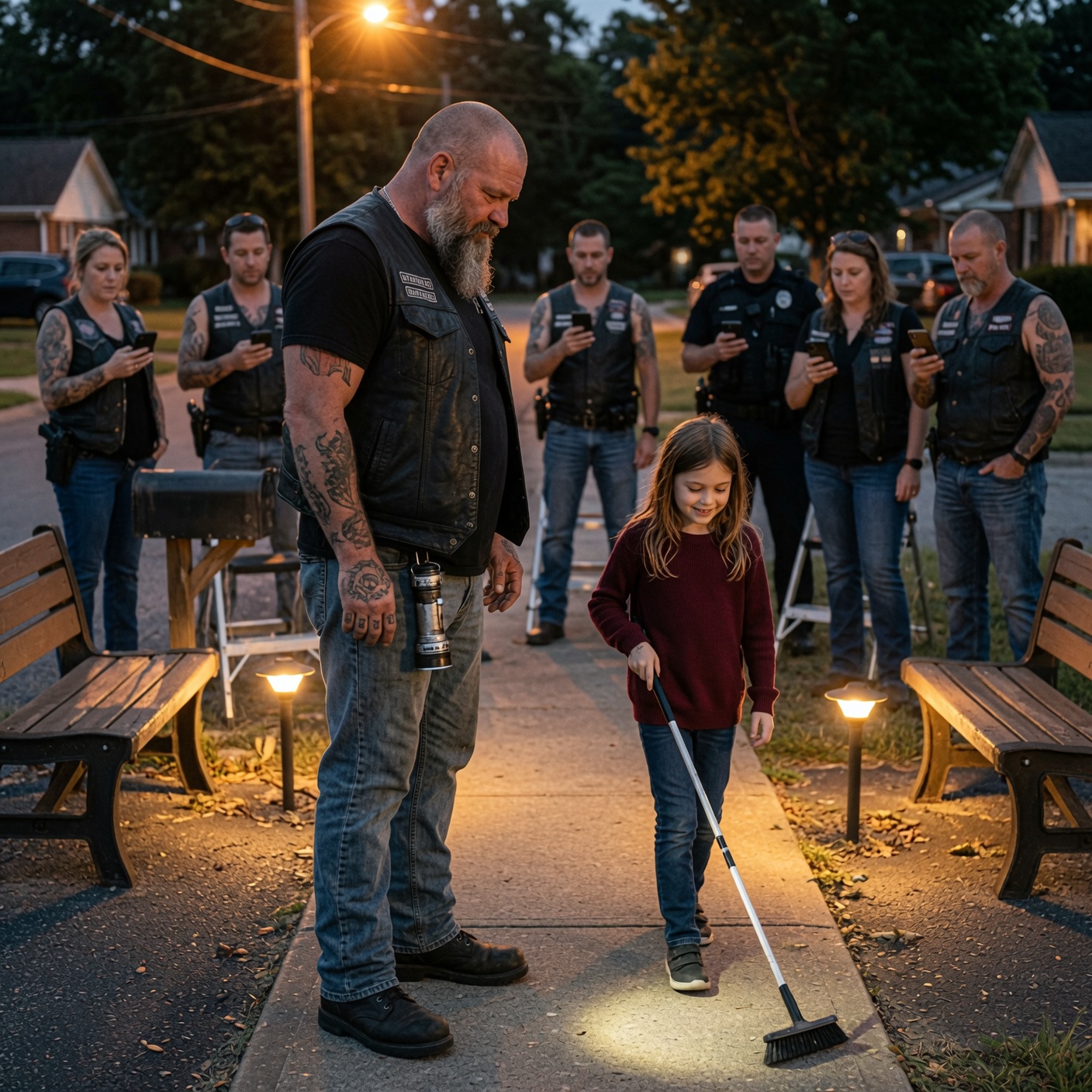
That evening, Emily stood at the beginning of the completed path.
The air was cool.
The tiny heated markers quietly came alive.
She closed her eyes instinctively, though she had never needed them.
Then she smiled.
“I can feel the first star.”
She walked forward.
One warm point…
then another.
The gentle heat touched the back of her hand, then her cheek as the path curved.
She never hesitated.
At every turn, she announced what came next before anyone spoke.
“A bench.”
“A mailbox.”
“A tree.”
“The little bridge.”
When she reached the final section beneath the old oak tree, she stopped.
The last marker wasn’t above her.
It was beside her.
A small bronze plaque had been mounted on the wooden railing.
She reached out and traced the raised letters with her fingertips.
They read:
Warm Star Road
Inspired by Lily Reid, whose dream helps others find their way.
Emily smiled.
“I think Lily’s here.”
Lucas quietly knelt beside the plaque.
For twelve years, he had carried those folded drawings inside his vest because looking at them hurt too much.
Now they were no longer hidden.
They had become a place where other children could walk safely.
Not just Emily.
Any child who might one day need a different way to experience the world.
Months later, schools, rehabilitation centers, and city planners began visiting Maple Ridge Drive.
They weren’t coming to admire Christmas lights.
They came to study an idea.
How warmth, touch, sound, and thoughtful design could create independence where sight could not.
The project was eventually adopted in several parks and therapy centers across the state.
People started calling it The Lily Path.
Nathan always corrected them.
“It was never about lights,” he would say.
“It was about listening to a child who imagined the world differently.”
And every year, on the anniversary of the project, fifty motorcycles rolled quietly onto Maple Ridge Drive.
No speeches.
No cameras.
No publicity.
Just fifty riders standing silently as Emily walked the path on her own.
Not following the lights.
Following the warmth that one little girl’s dream had left behind.
— THE END —